
ATSB Publishes Update On Cessna 210 Carry-Through Spar Failure | Aero-News Network
Aero-News Network
RSS icon RSS feed
podcast icon MP3 podcast
Subscribe Aero-News e-mail Newsletter Subscribe

Airborne Unlimited -- Most Recent Daily Episodes

Episode Date

Airborne-Monday

Airborne-Tuesday

Airborne-Wednesday Airborne-Thursday

Airborne-Friday

Airborne On YouTube

Airborne-Unlimited-12.08.25

AirborneNextGen-
12.09.25

Airborne-Unlimited-12.10.25

Airborne-FltTraining-12.04.25

AirborneUnlimited-12.05.25

AFE 2025 LIVE MOSAIC Town Hall (Archived): www.airborne-live.net

Tue, Jun 11, 2019

ATSB Publishes Update On Cessna 210 Carry-Through Spar Failure

Airplane Impacted Terrain Near Mount Isa, Queensland, On May 26

The ATSB has published an update on its investigation into the collision with terrain of Cessna 210 VH-SUX near Mount Isa, Queensland, Australia on May 26.

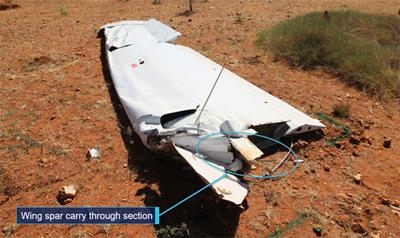
Evidence at the accident site indicated that the aircraft’s right wing had separated while in flight, resulting in a rapid loss of control and subsequent collision with terrain. The two pilots on board were fatally injured.

Subsequent technical examination confirmed the aircraft’s wing spar had fractured due to fatigue cracking, which reduced the spar’s structural integrity to the point where operational loads produced an overstress fracture.

“The ATSB has notified the Civil Aviation Safety Authority, the U.S. National Transportation Safety Board, the aircraft manufacturer and operator of the initial finding of fatigue cracking with the wing spar carry-through structure,” ATSB Executive Director Nat Nagy said. "The ATSB is working closely with those parties to ensure the continued safe operation of the the aircraft type."

The Cessna 210, which had been manufactured in 1976 and had accumulated over 12,000 flight hours, had been conducting a geological survey flight while flying at about 200 feet above ground level at the time of the accident.

The aircraft had been modified for geological survey work and had also been fitted with approved integral wing tip fuel tank and non-standard engine and propeller modifications.

“The ATSB notes that there is no evidence to indicate a connection between this accident and other recent investigations it has conducted involving this aircraft type,” Nagy said.

(Image provided with ATSB news release)

FMI: www.atsb.gov.au/publications/investigation_reports/2019/aair/ao-2019-026

Advertisement

More News

ANN's Daily Aero-Term (12.08.25): Decision Altitude (DA)

Decision Altitude (DA) A specified altitude (mean sea level (MSL)) on an instrument approach procedure (ILS, GLS, vertically guided RNAV) at which the pilot must decide whether to >[...]

ANN's Daily Aero-Linx (12.08.25)

Aero Linx: T-34 Association, Inc. The T-34 Association was formed in July 1975 so that individuals purchasing then military surplus T-34As had an organization which would provide s>[...]

NTSB Final Report: Piper PA-31T3

As He Released The Brakes To Begin Taxiing, The Brake Pedals Went To The Floor With No Braking Action Analysis: The pilot reported that during engine start up, he applied the brake>[...]

Aero-News: Quote of the Day (12.08.25)

“Legislation like the Mental Health in Aviation Act is still imperative to hold the FAA accountable for the changes they clearly acknowledge need to be made... We cannot wait>[...]

Airborne-Flight Training 12.04.25: Ldg Fee Danger, Av Mental Health, PC-7 MKX

Also: IAE Acquires Diamond Trainers, Army Drones, FedEx Pilots Warning, DA62 MPP To Dresden Tech Uni The danger to the flight training industry and our future pilots is clear. Dona>[...]

blog comments powered by Disqus



Advertisement

Advertisement

Podcasts

Advertisement

© 2007 - 2025 Web Development & Design by Pauli Systems, LC

