Scrambling To Attack This Year's First Major Wildland Fires In The Western U.S.
A steady build-up of privately operated helicopters and fixed wing tankers is in progress on three massive fires that have scorched thousands of acres in parts of Arizona and Colorado for more than a week.
The aircraft, all of which are being operated under exclusive use contracts from the US Forest Service (USFS) are being deployed as ground-based firefighters have made little progress. To date, the Hewlett Fire near Fort Collins, Colorado, has resulted in a loss of 5,000 acres, while in Arizona, more than 8,166 acres have been consumed by the Gladiator Fire, which has led to the evacuation of the nearby town of Crown King. The Sunflower Fire, barely 35 miles East of Crown King, has so far destroyed 14,465 acres.
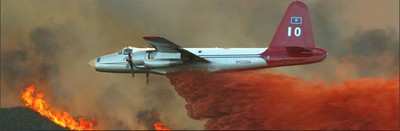
The three fires have generated a surge of aerial tanker support, including seven of the nine active, twin-engine fixed wing P2V Neptunes operated by Neptune Aviation Services, Inc., of Missoula, Montana. Of that number, six are in Arizona working from Prescott, and Phoenix-Mesa Gateway Airport, near Phoenix. An additional P2V was just deployed to Jefferson County Airport, outside of Denver, for duty on the Hewlett Fire. According to Loren Crea, the company's Director of Flight Operations, the six aircraft in Arizona, each supported by two pilots and two ground crew staff, are averaging a total of 15-20 flight hours daily, dropping fire retardant.
Erickson Air-Crane, a helitanker operator, has a single Erickson Air-Crane S64E fighting the Sunflower Fire, but the company has offered to send a second one, if needed, according to Mike Rotonda, Aerial Firefighting Manager of the Central Point, Oregon-based operation. The S64E is equipped with a 2,000 gallon capacity tank, capable of dropping water, foam, or fire retardant, and is flown by a two-person crew, and serviced by five on the ground. The aircraft, which has been working out of the town of Sunflower since May 12, is flying up to eight hours daily.
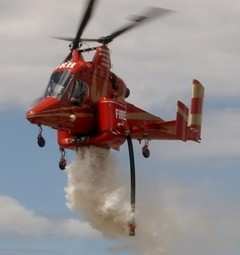
Bucket-equipped helicopters are also being ramped up. From Fort Collins, a heavy-lift, Kaman K-MAX 1200 is in action on the Hewlett Fire. Owned by Timberline Helicopters, Inc., of Laclede, Idaho, the helicopter is accompanied by two pilots, and four ground crew members,
A Columbia Model 234 Chinook helicopter, operated by Columbia Helicopters of Portland, Oregon, has been working the Gladiator Fire out of Prescott, according to company Public Relations Manager Dan Sweet. The helicopter is equipped with a 2,600-gallon SEI Torrentula Bambi Bucket equipped with the PowerFill system for water drops. The bucket, which is suspended as much as 180 feet below the helicopter, uses four high-volume pumps, enabling refills in under two minutes and from water sources as shallow as 18 inches.
Columbia's crew on the Chinook include two command pilots, two copilots, two maintenance Crew Chiefs, nine aircraft mechanics and one driver. It is averaging 6.6 flight hours daily.
Columbia Helicopters, Erickson Air-Crane, Neptune Aviation Services, and Timberline Helicopters are all members of the American Helicopter Services & Aerial Firefighting Association (AHSAFA), a Washington-based trade association representing commercial operators of helicopters and fixed wing aircraft engaged in aerial wildland firefighting.
“The severe wildland fires in Arizona and Colorado could preview of an especially difficult fire season throughout the West, following an unusually warm and dry winter,” said Tom Eversole, Executive Director of AHSAFA. “As in years past, the aerial firefighting industry has shown that it can respond immediately and effectively to a fire of any size, at any time--and any place.” (Top image P2V Neptune. Bottom image K-MAX)



 Classic Aero-TV: In Praise of Alabamas Patriot Aircraft USA


 See All