
TSB Highlights Findings From Fatal Floatplane Accident | Aero-News Network
Aero-News Network
RSS icon RSS feed
podcast icon MP3 podcast
Subscribe Aero-News e-mail Newsletter Subscribe

Airborne Unlimited -- Most Recent Daily Episodes

Episode Date

Airborne-Monday

Airborne-Tuesday

Airborne-Wednesday Airborne-Thursday

Airborne-Friday

Airborne On YouTube

Airborne-Unlimited-12.08.25

AirborneNextGen-
12.02.25

Airborne-Unlimited-12.03.25

Airborne-FltTraining-12.04.25

AirborneUnlimited-12.05.25

AFE 2025 LIVE MOSAIC Town Hall (Archived): www.airborne-live.net

Sat, Oct 10, 2020

TSB Highlights Findings From Fatal Floatplane Accident

2019 Crash Again Highlights Importance Of Stall Warning Systems 

In its investigation report (A19O0089) released this week, the Transportation Safety Board of Canada (TSB) identified that a loss of power and subsequent aerodynamic stall led to a collision with terrain near Hawk Lake, Ontario in 2019.

On 11 July 2019, a float-equipped de Havilland Beaver aircraft (DHC-2), operated by Hawk Air as an air taxi (Canadian Aviation Regulations Subpart 703), departed from the Hawk Junction Water Aerodrome, Ontario. Shortly after takeoff, during the initial climb out, just past the northeast end of Hawk Lake, the aircraft crashed in a steep nose-down attitude, severing a power line immediately before impact, and coming to rest next to a hydro substation. Both occupants were fatally injured.   

The investigation found that the aircraft likely departed with the fuel selector set to the rear tank position, which did not contain sufficient fuel for departure. As a result, the engine lost power due to fuel starvation during the initial climb. After a loss of power at low altitude, a left turn was likely attempted in an effort to either return to the departure lake or head toward more a desirable location for a forced landing. During the turn, an aerodynamic stall occurred, causing the aircraft to enter a spin and subsequently impact terrain.

The investigation also determined that, if aircraft are not equipped with a stall warning system, pilots and passengers who travel on these aircraft will remain exposed to an elevated risk of injury or death as a result of a stall at low altitude.

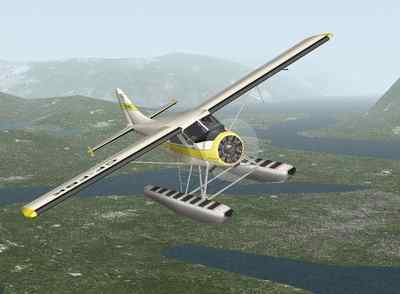
This safety issue is not new to the TSB. In October 2013, the Board issued a safety concern regarding the lack of a stall warning system in DHC-2 aircraft. In 2017, a Board recommendation called on the Department of Transport to require all commercially operated DHC-2 aircraft (file image pictured below) in Canada to be equipped with a stall warning system. Transport Canada has since completed a study on the issue and concluded that it will not require all commercially operated DHC-2 aircraft in Canada to be equipped with a stall warning system; as such, the risks associated with this safety deficiency remain.    

The investigation also found that, if air-taxi training requirements do not address the various classes of aircraft and operations included in the sector, there is a risk that significant type-, class-, or operation-specific emergency procedures will not be required to be included in training programs. Further, if seasonal air operators conduct recurrent training at the end of the season rather than at the beginning, there is a risk that pilots will not be as familiar with required emergency procedures at the start of each flying season. 

Following the occurrence, Hawk Air added more emphasis to its training for engine failures during critical phases of flight. Hawk Air has also made it mandatory for pilots and passengers to use both the lap strap and the shoulder harness for all operations.

FMI: www.canada.ca/en/transportation-safety-board.html

Advertisement

More News

NTSB Final Report: Patriot Aircraft LLC CX1900A

After Draining Both Wing Fuel Tanks, A Significant Amount Of Water Was Observed In The Right Wing Fuel Tank Analysis: The pilot, who was also the owner of the experimental amateur->[...]

Aero-News: Quote of the Day (12.06.25)

“Airbus apologises for any challenges and delays caused to passengers and airlines by this event. The Company thanks its customers, the authorities, its employees and all rel>[...]

ANN's Daily Aero-Term (12.06.25): High Speed Taxiway

High Speed Taxiway A long radius taxiway designed and provided with lighting or marking to define the path of aircraft, traveling at high speed (up to 60 knots), from the runway ce>[...]

ANN's Daily Aero-Linx (12.06.25)

Aero Linx: Taylorcraft Foundation, Inc. The Taylorcraft Foundation is exclusively organized for charitable, educational & scientific activities and will preserve the history an>[...]

Airborne-NextGen 12.02.25: Honda eVTOL, Arctus High-Alt UAS, Samson Patent

Also: USAF Reaper Accident, Baikonur Damage, Horizon eVTOL IFR/FIKI, New Glenn Update Honda has outlined its clearest timeline yet for its entry into the world of electric vertical>[...]

blog comments powered by Disqus



Advertisement

Advertisement

Podcasts

Advertisement

© 2007 - 2025 Web Development & Design by Pauli Systems, LC

