Panels Protect The Spacecraft During Launch
The three massive panels protecting a test version of NASA's Orion multipurpose crew vehicle successfully fell away from the spacecraft Wednesday in a test of a system that will protect Orion during its first trip to space next year.
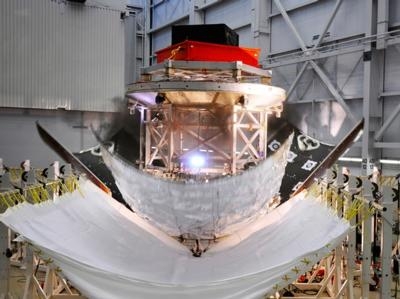
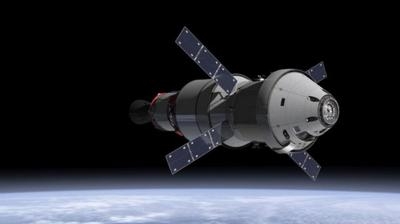
The panels, called fairings, encase Orion's service module and shield it from the heat, wind and acoustics it will experience during the spacecraft's climb into space. The service module, located directly below the crew capsule, will contain the in-space propulsion capability for orbital transfer, attitude control and high-altitude ascent aborts when Orion begins carrying humans in 2021. It also will generate and store power and provide thermal control, water and air for the astronauts. The service module will remain connected to the crew module until just before the capsule returns to Earth. During Exploration Flight Test-1 (EFT-1), the spacecraft's flight test next year, a test service module will be attached to the capsule.
"Hardware separation events like this are absolutely critical to the mission and some of the more complicated things we do," said Mark Geyer, Orion program manager at NASA's Johnson Space Center in Houston. "We want to know we've got the design exactly right and that it can be counted on in space before we ever launch."
Unlike conventional rocket fairings, these panels are designed to support half of the weight of Orion's crew module and launch abort system during launch and ascent, which improves performance, saves weight and maximizes the size and capability of the spacecraft. Each panel is 14 feet high and 13 feet wide.
The fairings' work is done soon after launch. They must be jettisoned when Orion has reached an altitude of about 560,000 feet. To make that possible, six breakable joints and six explosive separation bolts are used to connect the fairing panels to the rocket and each other. In a carefully timed sequence, the joints are fired apart, followed shortly by the bolts. Once all of the pyrotechnics have detonated, six spring assemblies will push the three panels away, leaving the service and crew module exposed to space as they travel onward.
This test, conducted by Orion's primary contractor, Lockheed Martin, at the company's Sunnyvale, CA, facility, was the second test of the fairing separation system. The first occurred in June, when one of the three fairing panels did not completely detach. Engineers determined the issue was caused when the top edge of the fairing came into contact with the adapter ring and kept it from rotating away and releasing from the spacecraft. Because of the engineers' confidence in successfully eliminating the interference, they maintained plans to increase this week's test fidelity by emulating the thermal loads experienced by the fairings during ascent. They used strip heaters to heat one of the fairings to 200 degrees Fahrenheit and simulate the temperatures the panels will experience.
Exploration Flight Test-1 is scheduled for September 2014. During that flight, an uncrewed Orion will launch to an altitude of 3,600 miles, more than 15 times farther into space than the International Space Station. It will orbit Earth twice before re-entering the atmosphere as fast as 20,000 mph.
The data gathered during the flight will influence design decisions, authenticate existing computer models, and innovative new approaches to space systems development.
(Upper image provided by Lockheed Martin. Lower image NASA artist's rendering)



 ANN's Daily Aero-Term (12.08.25): Decision Altitude (DA)


 See All