
NASA's Orion Spacecraft Proves Sound Under Pressure | Aero-News Network
Aero-News Network
RSS icon RSS feed
podcast icon MP3 podcast
Subscribe Aero-News e-mail Newsletter Subscribe

Airborne Unlimited -- Most Recent Daily Episodes

Episode Date

Airborne-Monday

Airborne-Tuesday

Airborne-Wednesday Airborne-Thursday

Airborne-Friday

Airborne On YouTube

Airborne-Unlimited-12.08.25

AirborneNextGen-
12.02.25

Airborne-Unlimited-12.03.25

Airborne-FltTraining-12.04.25

AirborneUnlimited-12.05.25

AFE 2025 LIVE MOSAIC Town Hall (Archived): www.airborne-live.net

Mon, Jun 10, 2013

NASA's Orion Spacecraft Proves Sound Under Pressure

Static Load Tests Completed This Week

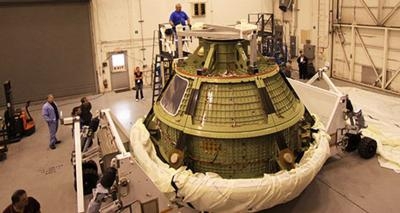
After a month of being poked, prodded and pressurized in ways that mimicked the stresses of spaceflight, NASA's Orion crew module successfully passed its static loads tests on Wednesday.

When Orion launches on Exploration Flight Test-1 (EFT-1), which is targeted for September 2014, it will travel farther from Earth than any spacecraft built for humans in more than 40 years. The spacecraft will fly about 3,600 miles above Earth's surface and return at speeds of approximately 25,000 mph. During the test, Orion will experience an array of stresses, or loads, including launch and reentry, the vacuum of space, and several dynamic events that will jettison hardware away from the spacecraft and deploy parachutes.

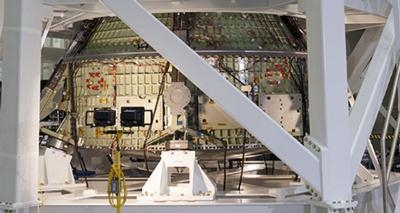
To ensure Orion will be ready for its flight test next year, engineers at NASA's Kennedy Space Center in Florida built a 20-foot-tall static loads test fixture for the crew module with hydraulic cylinders that slowly push or pull on the vehicle, depending on the type of load being simulated. The fixture produced 110 percent of the load caused by eight different types of stress Orion will experience during EFT-1. More than 1,600 strain gauges recorded how the vehicle responded. The loads ranged from as little as 14,000 pounds to as much as 240,000 pounds.

"The static loads campaign is our best method of testing to verify what works on paper will work in space," said Charlie Lundquist, NASA's Orion crew and service module manager at the agency's Johnson Space Center in Houston. "This is how we validate our design."

In addition to the various loads it sustained, the Orion crew module also was pressurized to simulate the effect of the vacuum in space. This simulation allowed engineers to confirm it would hold its pressurization in a vacuum and verify repairs made to superficial cracks in the vehicle's rear bulkhead caused by previous pressure testing in November.

The November test revealed insufficient margin in an area of the bulkhead that was unable to withstand the stress of pressurization. Armed with data from that test, engineers were able to reinforce the design to ensure structural integrity and validate the fix during this week's test.

To repair the cracks, engineers designed brackets that spread the stress of being pressurized to other areas of the module that are structurally stronger. During these tests Orion was successfully pressurized to 110 percent of what it would experience in space, demonstrating it is capable of performing as necessary during EFT-1.

FMI: www.nasa.gov

Advertisement

More News

NTSB Final Report: Patriot Aircraft LLC CX1900A

After Draining Both Wing Fuel Tanks, A Significant Amount Of Water Was Observed In The Right Wing Fuel Tank Analysis: The pilot, who was also the owner of the experimental amateur->[...]

Aero-News: Quote of the Day (12.06.25)

“Airbus apologises for any challenges and delays caused to passengers and airlines by this event. The Company thanks its customers, the authorities, its employees and all rel>[...]

ANN's Daily Aero-Term (12.06.25): High Speed Taxiway

High Speed Taxiway A long radius taxiway designed and provided with lighting or marking to define the path of aircraft, traveling at high speed (up to 60 knots), from the runway ce>[...]

ANN's Daily Aero-Linx (12.06.25)

Aero Linx: Taylorcraft Foundation, Inc. The Taylorcraft Foundation is exclusively organized for charitable, educational & scientific activities and will preserve the history an>[...]

Airborne-NextGen 12.02.25: Honda eVTOL, Arctus High-Alt UAS, Samson Patent

Also: USAF Reaper Accident, Baikonur Damage, Horizon eVTOL IFR/FIKI, New Glenn Update Honda has outlined its clearest timeline yet for its entry into the world of electric vertical>[...]

blog comments powered by Disqus



Advertisement

Advertisement

Podcasts

Advertisement

© 2007 - 2025 Web Development & Design by Pauli Systems, LC

