
Pilot Aborts Landing At BOS After TCAS Warning | Aero-News Network
Aero-News Network
RSS icon RSS feed
podcast icon MP3 podcast
Subscribe Aero-News e-mail Newsletter Subscribe

Airborne Unlimited -- Most Recent Daily Episodes

Episode Date

Airborne-Monday

Airborne-Tuesday

Airborne-Wednesday Airborne-Thursday

Airborne-Friday

Airborne On YouTube

Airborne-Unlimited-12.08.25

AirborneNextGen-
12.02.25

Airborne-Unlimited-12.03.25

Airborne-FltTraining-12.04.25

AirborneUnlimited-12.05.25

AFE 2025 LIVE MOSAIC Town Hall (Archived): www.airborne-live.net

Sat, Mar 10, 2007

Pilot Aborts Landing At BOS After TCAS Warning

Jets Had Adequate Separation

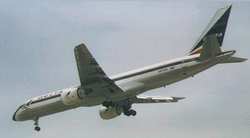
A Delta pilot aborted a landing Tuesday at Logan International Airport in Boston, after an onboard traffic collision avoidance system alarm sounded. At 4:37 pm, the TCAS system onboard the Boeing 757 detected the presence of a Delta Connection regional jet operated by Chautauqua Airlines. Both planes were descending over Hingham Bay toward the airport in gusty winds.

Radar data indicates the 757 was about 100 feet above a Delta Connection regional jet -- but the jets had approximately 3,500 feet of horizontal separation, FAA spokesman Jim Peters said Thursday.

"There was no potential for a collision," Peters said.

After performing the go-around, the Delta pilot radioed that the other jet was "just about 100 feet below us," according to Boston's Patriot Ledger.

Controllers warned both pilots to keep each other in sight during their descents toward nearly parallel runways. Both pilots acknowledged the order, Peters said.

It was unlikely the pilots mistook another jet in the area for the one they were instructed to keep in sight, Peters said.

The Atlanta, GA-based airline is investigating the incident.

"Anything that's not a normal routine flight operation, we would have a report from our pilots and launch an investigation and get everyone's side of the story," spokeswoman Gina Loughlin said.

The landing patterns used Tuesday are a new configuration, since the opening of a new runway at Logan in November 2006.

When crosswinds gust to 10 knots or greater, smaller aircraft can use Runway 14/32. Larger aircraft make staggered landings on the nearly parallel Runway 33L only when clear conditions prevail, to enable pilots to properly monitor the position of other aircraft.

FMI: www.delta.com

Advertisement

More News

NTSB Final Report: Patriot Aircraft LLC CX1900A

After Draining Both Wing Fuel Tanks, A Significant Amount Of Water Was Observed In The Right Wing Fuel Tank Analysis: The pilot, who was also the owner of the experimental amateur->[...]

Aero-News: Quote of the Day (12.06.25)

“Airbus apologises for any challenges and delays caused to passengers and airlines by this event. The Company thanks its customers, the authorities, its employees and all rel>[...]

ANN's Daily Aero-Term (12.06.25): High Speed Taxiway

High Speed Taxiway A long radius taxiway designed and provided with lighting or marking to define the path of aircraft, traveling at high speed (up to 60 knots), from the runway ce>[...]

ANN's Daily Aero-Linx (12.06.25)

Aero Linx: Taylorcraft Foundation, Inc. The Taylorcraft Foundation is exclusively organized for charitable, educational & scientific activities and will preserve the history an>[...]

Airborne-NextGen 12.02.25: Honda eVTOL, Arctus High-Alt UAS, Samson Patent

Also: USAF Reaper Accident, Baikonur Damage, Horizon eVTOL IFR/FIKI, New Glenn Update Honda has outlined its clearest timeline yet for its entry into the world of electric vertical>[...]

blog comments powered by Disqus



Advertisement

Advertisement

Podcasts

Advertisement

© 2007 - 2025 Web Development & Design by Pauli Systems, LC

