Wed, Jul 11, 2012
EASA Certification Also Secured, Transport Canada Expected To Follow Suit Soon
The FAA has approved the S-92 helicopter manufactured by Sikorsky for Sea State 6 (SS6) conditions, completing the S-92A emergency flotation system sea state expansion and bringing further mission capability to operators. The FAA Sea State 6 certification was achieved on May 30, followed by certification by the European Aviation Safety Agency (EASA). Certification by Transport Canada is expected soon.
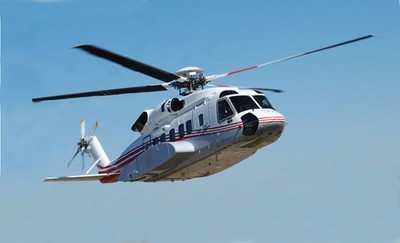
The S-92 helicopter (pictured in file photo) has an optional Emergency Flotation System (EFS) that consists of three primary floats. The three-float system has now been certified for ditching in conditions up to and including Sea State 5. An additional option provides two additional floats. The five-float flotation system is now certified for ditching in conditions up to and including Sea State 6.
"Many of our operators, particularly those in the North Sea and Canadian waters, require certification higher than Sea State 4 because of the winter conditions they face," said Peter Barner, lead landing gear designer for the S-92 helicopter. "Now, despite very severe weather conditions, even more critical offshore oil missions, and search-and-rescue operations can be performed with great confidence."
Dan Hunter, Director, Sikorsky Commercial Programs, said: "The S-92 helicopter is the aircraft of choice for many customers who operate in the most demanding environments and conditions for critical missions and we are committed to responding to our customers' needs. The S-92 helicopter meets or exceeds the safety requirements set by the industry and we will continue to strive to make the aircraft as safe as possible for our operators."
As a dedicated search and rescue platform, the S-92 aircraft is equipped with advanced systems and hardware, including an automated flight control system that enables the pilot to fly pre-programmed search patterns and perform delicate hover maneuvers; a wireless intercom allowing a rescue swimmer to communicate with the crew; radio transceivers to communicate with ships, police and other emergency rescue services; a weather radar; a forward looking infrared sensor; and a digital video system to record rescues. The aircraft also comes with a dual rescue hoist, single or dual 220-gallon internal auxiliary fuel tanks, three litters, and a rescue searchlight.
More News
Decision Altitude (DA) A specified altitude (mean sea level (MSL)) on an instrument approach procedure (ILS, GLS, vertically guided RNAV) at which the pilot must decide whether to >[...]
Aero Linx: T-34 Association, Inc. The T-34 Association was formed in July 1975 so that individuals purchasing then military surplus T-34As had an organization which would provide s>[...]
As He Released The Brakes To Begin Taxiing, The Brake Pedals Went To The Floor With No Braking Action Analysis: The pilot reported that during engine start up, he applied the brake>[...]
“Legislation like the Mental Health in Aviation Act is still imperative to hold the FAA accountable for the changes they clearly acknowledge need to be made... We cannot wait>[...]
Also: IAE Acquires Diamond Trainers, Army Drones, FedEx Pilots Warning, DA62 MPP To Dresden Tech Uni The danger to the flight training industry and our future pilots is clear. Dona>[...]



 ANN's Daily Aero-Term (12.08.25): Decision Altitude (DA)


 See All