Wind Tunnel Test Designed To Validate The Aerodynamic Performance And Flight Mechanics Of Sikorsky’s X2 Technology Aircraft
The U.S. Army is looking to improve its aviation technology and recently called upon the AEDC National Full-Scale Aerodynamics Complex at Moffett Field in Mountain View, CA, to advance this effort.

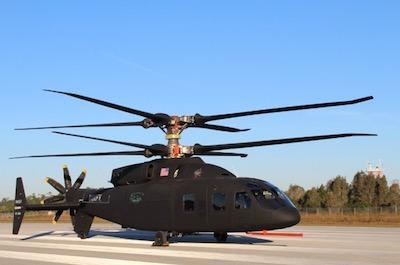
Engineers from Sikorsky Aircraft Corporation and The Boeing Company, in partnership with the U.S. Army Combat Capabilities Development Command Aviation & Missile Center Army Aviation Development Directorate, recently conducted a series of tests at NFAC to support the development of the SB>1 DEFIANT, a military helicopter being developed for the Army’s Joint Multi-Role Technology Demonstrator (JMR TD) program.
The goal of this wind tunnel test was to validate the aerodynamic performance and flight mechanics of Sikorsky’s X2 Technology aircraft. These configurations, which are being utilized on the SB>1 DEFIANT, include a lift-offset coaxial rotor system, composite fuselage and rear-mounted pusher propulsor that provides increased speed.
The SB>1 DEFIANT, which made its first flight in March, is a technology demonstrator for a medium-lift utility helicopter. Future uses of this type of air vehicle could include attack and assault, troop transport or MEDEVAC.
The testing was conducted throughout the first half of 2019 and concluded in mid-June. To accomplish the tests, a 1/5 scale model of the SB>1 DEFIANT airframe with powered coaxial main rotors was placed in the NFAC 40- by 80-foot wind tunnel. Measurements included forces and moments on the various components, as well as fuselage, empennage and blade surface pressures.
David Wang, NFAC test engineer, said the recent tests expanded on data collected from a JMR wind tunnel entry conducted at NFAC in 2016 by gathering data at faster speed ranges. “From the NFAC perspective, the wind tunnel test was successful,” Wang said. “The test customer was able to collect performance and handling qualities data for their subscale model up to their maximum design flight speed.”
Data collected during the recent tests is undergoing review and analysis. It is unknown at this time if there will be future testing of the SB>1 DEFIANT model at NFAC.
The full-scale SB>1 DEFIANT flight demonstrator is currently undergoing ground and flight tests at Sikorsky’s flight test facility. According to the Sikorsky-Boeing JMR Team, data from SB>1 DEFIANT will help the Army develop requirements for new utility helicopters expected to enter service in the early 2030s.
A previous DOD study concluded that upgrades to the aging DOD rotary wing aviation fleet would not provide the capabilities required for future operations. Significant improvement in several attributes of fleet aircraft, such as speed, payload, range, survivability and vertical lift are required to meet future needs. It was determined this improvement could be achieved through application of new technologies and designs.
To accomplish its goal, the Army has been executing a science & technology (S&T) effort to mitigate risk associated with maturity of critical technologies, feasibility of desired capabilities and cost of a technical solution. An aspect of this effort is the air vehicle development associated with the JMR TD program.
JMR TD is the alignment of Army Aviation’s S&T with the Future Vertical Lift initiative, which seeks to develop a new family of system to modernize and replace the government’s current fleet of rotorcraft. According to the Army, the intent of the JMR TD is to mitigate risk for the Future Vertical Lift program through means that include the testing of advanced technologies and efficient vehicle configurations.
NFAC, managed and operated by Arnold Engineering Development Complex (AEDC), is the largest wind tunnel complex in the world. It consists of both the 40- by 80-foot and 80- by 120- foot wind tunnels. These tunnels, which share a common drive system, are primarily used for aerodynamic and acoustic tests of rotorcraft and fixed wing, powered-lift V/STOL aircraft and developing advanced technologies for these vehicles.
Both subscale and full-scale models are tested at NFAC. The speed range of the 40- by 80-foot wind tunnel test section is continuously variable from 0 to 300 knots, while the speed range in the 80- by 120-foot wind tunnel section is continuously variable from 0 to 100 knots.
(Images provided with USAF news release)



 NTSB Final Report: Patriot Aircraft LLC CX1900A


 See All