
Scan Eagle UAV Conducts First Flight On LPD Class Ship | Aero-News Network
Aero-News Network
RSS icon RSS feed
podcast icon MP3 podcast
Subscribe Aero-News e-mail Newsletter Subscribe

Airborne Unlimited -- Most Recent Daily Episodes

Episode Date

Airborne-Monday

Airborne-Tuesday

Airborne-Wednesday Airborne-Thursday

Airborne-Friday

Airborne On YouTube

Airborne-Unlimited-12.08.25

AirborneNextGen-
12.09.25

Airborne-Unlimited-12.10.25

Airborne-AffordableFlyers-12.11.25

AirborneUnlimited-12.12.25

AFE 2025 LIVE MOSAIC Town Hall (Archived): www.airborne-live.net

Fri, Dec 14, 2012

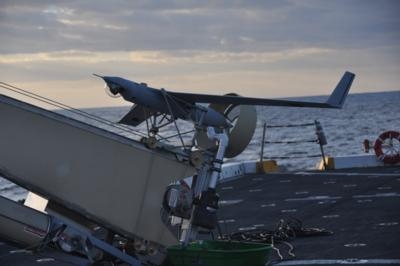
Scan Eagle UAV Conducts First Flight On LPD Class Ship

First Operational Deployment Aboard The USS San Antonio Is Planned For Next Summer

A Scan Eagle Unmanned Air Vehicle was launch-tested aboard the amphibious transport dock class ship USS San Antonio (LPD 17) on Nov. 28 off the coast of North Carolina. The flight on the San Antonio LPD class ship was part of a post-installation and functional flight-check exercise. Scan Eagle’s first deployment aboard USS San Antonio is planned for summer 2013.

Since 2005, Scan Eagle has flown nearly 250,000 hours under the Naval Air Systems Command's Intelligence, Surveillance and Reconnaissance (ISR) services contract. Defense contractor Insitu owns and operates the Scan Eagle UAV.

The 44-pound UAV is predominately flown off Navy DDG-51 destroyers. Recent and upcoming ISR services on amphibious warfare ships are a precursor for the Navy and Marine Corps' plans to field and operate the expeditionary RQ-21A Small Tactical Unmanned Air System from the sea. The RQ-21A Integrator just completed land-based testing and is scheduled to begin shipboard testing early next year.

According to the Navy, the Scan Eagle unmanned air vehicle was designed for long endurance capability. Scan Eagle features a high aspect ratio swept wing, shoulder-mounted on a cylindrical fuselage using blended fairings. The air vehicle is tailless, with a rear-mounted engine driving a pusher propeller. The structure is carbon fiber composite with fiberglass winglets. Two sets of elevons on the wings provide pitch and roll control, with rudders on the winglets at the wingtips for directional control.

The Super Wedge catapult provides the initial velocity and rate of climb. The catapult requires approximately 45-75 PSI compressed air (depending on weight and wind) to charge the system. The pneumatic catapult is charged from a remotely operated air compressor attached to the launcher.

FMI: www.navy.mil

Advertisement

More News

Aero-News: Quote of the Day (12.11.25)

"The owners envisioned something modern and distinctive, yet deeply meaningful. We collaborated closely to refine the flag design so it complemented the aircraft’s contours w>[...]

ANN's Daily Aero-Term (12.11.25): Nonradar Arrival

Nonradar Arrival An aircraft arriving at an airport without radar service or at an airport served by a radar facility and radar contact has not been established or has been termina>[...]

Classic Aero-TV: David Uhl and the Lofty Art of Aircraft Portraiture

From 2022 (YouTube Edition): Still Life with Verve David Uhl was born into a family of engineers and artists—a backdrop conducive to his gleaning a keen appreciation for the >[...]

Airborne-NextGen 12.09.25: Amazon Crash, China Rocket Accident, UAV Black Hawk

Also: Electra Goes Military, Miami Air Taxi, Hypersonics Lab, MagniX HeliStrom Amazon’s Prime Air drones are back in the spotlight after one of its newest MK30 delivery drone>[...]

Airborne 12.05.25: Thunderbird Ejects, Lost Air india 737, Dynon Update

Also: Trailblazing Aviator Betty Stewart, Wind Farm Scrutiny, Chatham Ban Overturned, Airbus Shares Dive A Thunderbird pilot, ID'ed alternately as Thunderbird 5 or Thunderbird 6, (>[...]

blog comments powered by Disqus



Advertisement

Advertisement

Podcasts

Advertisement

© 2007 - 2025 Web Development & Design by Pauli Systems, LC

