
NASA'S DC-8 Flying Lab Departs Dryden For UND | Aero-News Network
Aero-News Network
RSS icon RSS feed
podcast icon MP3 podcast
Subscribe Aero-News e-mail Newsletter Subscribe

Airborne Unlimited -- Most Recent Daily Episodes

Episode Date

Airborne-Monday

Airborne-Tuesday

Airborne-Wednesday Airborne-Thursday

Airborne-Friday

Airborne On YouTube

Airborne-SpecialEpisode-12.15.25

AirborneNextGen-
12.16.25

Airborne-Unlimited-12.10.25

Airborne-AffordableFlyers-12.11.25

AirborneUnlimited-12.12.25

AFE 2025 LIVE MOSAIC Town Hall (Archived): www.airborne-live.net

Sat, Sep 17, 2005

NASA'S DC-8 Flying Lab Departs Dryden For UND

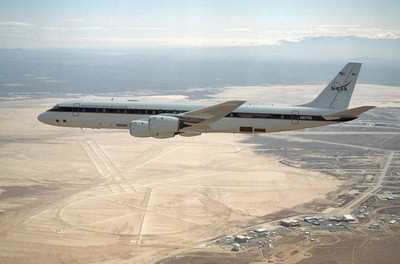
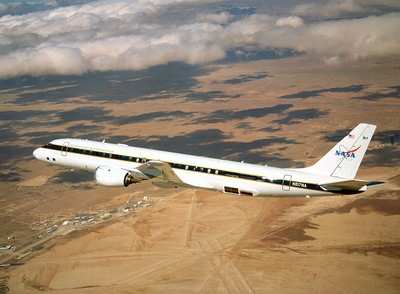
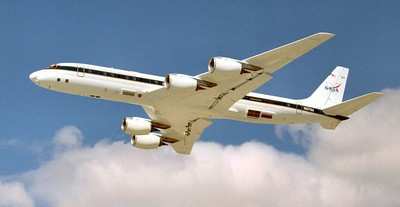
NASA's DC-8 flying laboratory tipped its wings in farewell as it departed the Dryden Flight Research Center at Edwards Air Force Base, Calif., for its new home at Grand Forks, N.D., on Sept. 14.

NASA recently signed a cooperative agreement with the University of North Dakota, Grand Forks, and will pay the university $25 million over a five-year period to maintain and operate the agency's DC-8 science research aircraft. The plan is for the DC-8 to be the centerpiece of a new National Suborbital Education and Research Center at the university. The agreement is intended to expand science research capabilities using the DC-8 and enhance hands-on educational opportunities for students.

Built as an extended-range jetliner in 1966, the DC-8 was acquired by NASA from Alitalia Airlines in 1985 and modified to convert it to a flying science laboratory. It was first operated by NASA's Ames Research Center, Moffett Field, Calif. from 1986 to 1997, and transferred to Dryden late that year.

The DC-8 has supported satellite validation, Earth science studies, and the development of remote sensing techniques for space-based observing systems. It has deployed worldwide to support research including measuring ozone and other gases with two winter deployments to Kiruna, Sweden, for the SAGE III Ozone Loss and Validation Experiments I and II. The aircraft has also carried scientists and their instruments into the eyes of several hurricanes with the goal of improving predictions of the storms' movements and increasing warning time to the affected areas.

Although based in North Dakota, the aircraft will continue to be owned by NASA, and will be flown by NASA flight crews for the foreseeable future. Operational management will be transferred from NASA Dryden to the NASA Goddard Space Flight Center's Wallops Flight Facility in Virginia.

FMI: www.dfrc.nasa.gov

Advertisement

More News

ANN's Daily Aero-Term (12.14.25): Local Airport Advisory (LAA)

Local Airport Advisory (LAA) A service available only in Alaska and provided by facilities that are located on the landing airport, have a discrete ground-to-air communication freq>[...]

Airborne 12.08.25: Samaritan’s Purse Hijack, FAA Med Relief, China Rocket Fail

Also: Cosmonaut Kicked Out, Airbus Scales Back, AF Silver Star, Russian A-60 Clobbered A Samaritan’s Purse humanitarian flight was hijacked on Tuesday, December 2, while atte>[...]

ANN's Daily Aero-Linx (12.15.25)

Aero Linx: Michigan Helicopter Association (MHA) The Michigan Helicopter Association (MHA) exists to bring together people who share an interest in helicopters, including private, >[...]

Airborne 12.10.25: New Gulfstream, ATC Integrator, Outrageous FFZ User Fees

Also: Airbus Acquisition, USCG Helo Sniper, Remember Pearl Harbor, New Thunderbird 1 Gulfstream’s newest addition to its next-gen lineup, the super-midsize G300, is officiall>[...]

Airborne-NextGen 12.09.25: Amazon Crash, China Rocket Accident, UAV Black Hawk

Also: Electra Goes Military, Miami Air Taxi, Hypersonics Lab, MagniX HeliStrom Amazon’s Prime Air drones are back in the spotlight after one of its newest MK30 delivery drone>[...]

blog comments powered by Disqus



Advertisement

Advertisement

Podcasts

Advertisement

© 2007 - 2025 Web Development & Design by Pauli Systems, LC

