"Observed" Age Is Just 30 Years
Astronomers using NASA's Chandra X-ray Observatory have found
evidence of the youngest black hole known to exist in our cosmic
neighborhood. The 30-year-old black hole provides a unique
opportunity to watch this type of object develop from infancy. The
black hole could help scientists better understand how massive
stars explode, which ones leave behind black holes or neutron
stars, and the number of black holes in our galaxy and others.
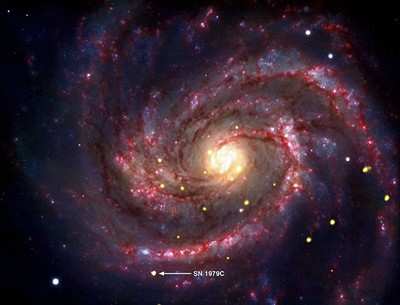
NASA Chandra Image
The 30-year-old object is a remnant of SN 1979C, a supernova in
the galaxy M100 approximately 50 million light years from Earth.
Data from Chandra, NASA's Swift satellite, the European Space
Agency's XMM-Newton and the German ROSAT observatory revealed a
bright source of X-rays that has remained steady during observation
from 1995 to 2007. This suggests the object is a black hole being
fed either by material falling into it from the supernova or a
binary companion.
"If our interpretation is correct, this is the nearest example
where the birth of a black hole has been observed," said Daniel
Patnaude of the Harvard-Smithsonian Center for Astrophysics in
Cambridge, MA, who led the study.
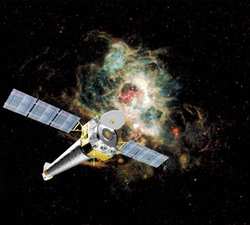
Chandra Observatory NASA Illustration
The scientists think SN 1979C, first discovered by an amateur
astronomer in 1979, formed when a star about 20 times more massive
than the sun collapsed. Many new black holes in the distant
universe previously have been detected in the form of gamma-ray
bursts (GRBs). However, SN 1979C is different because it is much
closer and belongs to a class of supernovas unlikely to be
associated with a GRB. Theory predicts most black holes in the
universe should form when the core of a star collapses and a GRB is
not produced. "This may be the first time the common way of making
a black hole has been observed," said co-author Abraham Loeb, also
of the Harvard-Smithsonian Center for Astrophysics. "However, it is
very difficult to detect this type of black hole birth because
decades of X-ray observations are needed to make the case."
The idea of a black hole with an observed age of only about 30
years is consistent with recent theoretical work. In 2005, a theory
was presented that the bright optical light of this supernova was
powered by a jet from a black hole that was unable to penetrate the
hydrogen envelope of the star to form a GRB. The results seen in
the observations of SN 1979C fit this theory very well. Although
the evidence points to a newly formed black hole in SN 1979C,
another intriguing possibility is that a young, rapidly spinning
neutron star with a powerful wind of high energy particles could be
responsible for the X-ray emission. This would make the object in
SN 1979C the youngest and brightest example of such a "pulsar wind
nebula" and the youngest known neutron star. The Crab pulsar, the
best-known example of a bright pulsar wind nebula, is about 950
years old. "It's very rewarding to see how the commitment of some
of the most advanced telescopes in space, like Chandra, can help
complete the story," said Jon Morse, head of the Astrophysics
Division at NASA's Science Mission Directorate.

The results will appear in the New Astronomy journal in a paper
by Patnaude, Loeb, and Christine Jones of the Harvard-Smithsonian
Center for Astrophysics. NASA's Marshall Space Flight Center in
Huntsville, Ala., manages the Chandra program for the agency's
Science Mission Directorate in Washington. The Smithsonian
Astrophysical Observatory controls Chandra's science and flight
operations from Cambridge.



 ANN's Daily Aero-Term (12.14.25): Local Airport Advisory (LAA)


 See All