

Honeywell Increases UAV Range Threefold, Using Cleaner Quieter Fuel | Aero-News Network
Aero-News Network
RSS icon RSS feed
podcast icon MP3 podcast
Subscribe Aero-News e-mail Newsletter Subscribe

Airborne Unlimited -- Most Recent Daily Episodes

Episode Date

Airborne-Monday

Airborne-Tuesday

Airborne-Wednesday Airborne-Thursday

Airborne-Friday

Airborne On YouTube

Airborne-Unlimited-12.08.25

AirborneNextGen-
12.09.25

Airborne-Unlimited-12.10.25

Airborne-AffordableFlyers-12.11.25

AirborneUnlimited-12.05.25

AFE 2025 LIVE MOSAIC Town Hall (Archived): www.airborne-live.net

Thu, Aug 19, 2021

Honeywell Increases UAV Range Threefold, Using Cleaner Quieter Fuel

BVLOS Solutions Suite Seeks To Improve How UAVs Navigate 

Honeywell’s Beyond Visual Line of Sight systems are ideal to equip drones for missions where there is likely to be interference. Applications can include last-mile package delivery, military intelligence, surveillance and reconnaissance, pipeline and power line inspection, search and rescue, or use by first responders.

“These are technologies that businesses have been waiting for,” said Stéphane Fymat, vice president and general manager of Honeywell’s Unmanned Aerial Systems and Urban Air Mobility business unit. “They will help make drones profitable for a world of new applications.”

The BVLOS suite comprises:

  • Honeywell’s 600-watt and 1200-watt hydrogen fuel cells
  • Honeywell’s RDR-84K multipurpose radar
  • Honeywell’s inertial measurement units (IMUs)
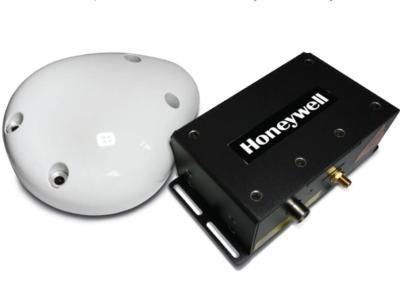
  • Honeywell’s UAV SATCOM - the world’s smallest and lightest satellite transceiver

According to the company, the fuel cells in the BVLOS suite operate three times longer than batteries with equivalent output and work silently. Refueling or swapping hydrogen tanks can be done swiftly, enabling more time in the air. Honeywell’s RDR-84K is a phased-array radar that steers beams electronically, meaning it has no moving parts and requires minimal maintenance. It also requires no heavy cooling systems.

In addition to avoiding other aircraft, the radar can detect obstacles, map terrain, and identify landing zones.

Honeywell’s UAV Satcom (pictured) and IMUs are available now.

“These innovations give drone builders and operators a whole new range of options,” said Sapan Shah, product manager for Honeywell’s Unmanned Aerial Systems and Urban Air Mobility business unit. “More time in the air, more awareness of surroundings and traffic, better connectivity: These are the building blocks of safe, profitable drone operations of all kinds, and that’s what we’re delivering.”

FMI: www.honeywell.com

Advertisement

More News

ANN's Daily Aero-Term (12.08.25): Decision Altitude (DA)

Decision Altitude (DA) A specified altitude (mean sea level (MSL)) on an instrument approach procedure (ILS, GLS, vertically guided RNAV) at which the pilot must decide whether to >[...]

ANN's Daily Aero-Linx (12.08.25)

Aero Linx: T-34 Association, Inc. The T-34 Association was formed in July 1975 so that individuals purchasing then military surplus T-34As had an organization which would provide s>[...]

NTSB Final Report: Piper PA-31T3

As He Released The Brakes To Begin Taxiing, The Brake Pedals Went To The Floor With No Braking Action Analysis: The pilot reported that during engine start up, he applied the brake>[...]

Aero-News: Quote of the Day (12.08.25)

“Legislation like the Mental Health in Aviation Act is still imperative to hold the FAA accountable for the changes they clearly acknowledge need to be made... We cannot wait>[...]

Airborne-Flight Training 12.04.25: Ldg Fee Danger, Av Mental Health, PC-7 MKX

Also: IAE Acquires Diamond Trainers, Army Drones, FedEx Pilots Warning, DA62 MPP To Dresden Tech Uni The danger to the flight training industry and our future pilots is clear. Dona>[...]

blog comments powered by Disqus



Advertisement

Advertisement

Podcasts

Advertisement

© 2007 - 2025 Web Development & Design by Pauli Systems, LC

