Mon, Jun 04, 2018
NOAA, Oceans Unmanned And DJI Team Up For Rescue Efforts
Every fall, pods of enormous humpback whales make their way towards Hawaii, where they can ride out the winter in warm waters of NOAA's Hawaiian Islands Humpback Whale National Marine Sanctuary. For centuries humans have watched this noble migration with awe and wonder. But today, an ever-growing number of these amazing animals are finding themselves in grave danger, entrapped in fishing gear and other marine debris.
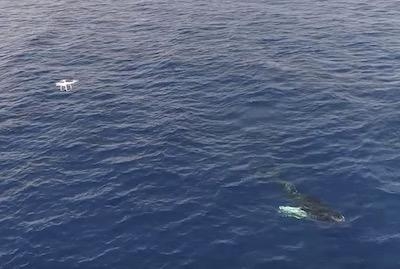
Specialists from the National Oceanic and Atmospheric Administration (NOAA) have worked with local volunteers to help save the whales by launching small boats with trained teams to disentangle them while in the water. It’s risky work, bringing people into close contact with the gigantic mammals. Knives on long poles work to cut free ropes that have sunk deep into the whales flesh. Last year, a volunteer was killed when a whale struck him.
To help make the process safer, the whale rescue squads are turning to a new technology: drones.
Matt Pickett, a former NOAA sanctuary manager, is now the founder of Oceans Unmanned, a non-profit organization that facilitates the use of drone technology for marine conservation. Oceans Unmanned recently unveiled the freeFLY program, a new initiative designed to provide aerial support using small drones for large whale entanglement response efforts.
“In the past, we had to get close to the whales at least three times,” explains Pickett. “Once to figure out where the animal was entangled, once to cut them free, and once to make sure the job was done right and nothing was left behind.”
With drones, the team can cut that down to just one step. Using small, remote controlled quadcopters with powerful cameras they can do their initial assessment and final check. "It makes the entire process much safer for both the humans and the whales."
(Source: DJI news release. Image from provided video. Imagery of whales taken by UAS platforms and those depicting rescue activities were conducted pursuant to and under the oversight of NOAA Fisheries’ Marine Mammal Health and Stranding Response Program (Permit Numbers 932-1905 and 18786.) Permits were issued under the authority of the Marine Mammal Protection Act and the Endangered Species Act)
More News
Convective SIGMET A weather advisory concerning convective weather significant to the safety of all aircraft. Convective SIGMETs are issued for tornadoes, lines of thunderstorms, e>[...]
Aero Linx: United Flying Octogenarians WELCOME to a most extraordinary group of aviators, the United Flying Octogenarians (UFO). Founded in 1982 with just a handful of pilots, we h>[...]
Pilot’s Decision To Attempt Takeoff With Frost Covering The Airplane’s Wings Analysis: The pilot of the light sport airplane was preparing to depart for a cross-country>[...]
“We’ve paid for the cable line’s repair for the customer and have apologized for the inconvenience this caused them...” Source: Some followup info from an A>[...]
Coupled Approach An instrument approach performed by the aircraft autopilot, and/or visually depicted on the flight director, which is receiving position information and/or steerin>[...]



 ANN's Daily Aero-Term (12.01.25): Convective SIGMET


 See All