Mon, Dec 04, 2017
Will Provide Next-Gen Weather Satellite
The U.S. Air Force Space and Missile Systems Center (SMC) has selected Ball Aerospace to deliver the next-generation operational environmental satellite system, Weather System Follow-on – Microwave (WSF-M), for the Department of Defense (DoD). WSF-M is a predominantly fixed price contract that will provide for system design and risk reduction of a Low Earth Orbit (LEO) satellite with a passive microwave imaging radiometer instrument and hosted Government furnished energetic charged particle (ECP) sensor. The contract will include options for the development and fabrication of two LEO satellites as well as options for launch vehicle integration, launch and early orbit test, and operational test and evaluation support. This mission will improve weather forecasting over maritime regions by taking global measurements of the atmosphere and ocean surface.
"This is an exciting win for us, and we're looking forward to expanding our work with the Air Force and continuing to support warfighters and allies around the world," said Rob Strain, president, Ball Aerospace. "WSF-M extends Ball's legacy of providing precise measurements from space to enable more accurate weather forecasting."
As the prime contractor, Ball will be responsible for developing and integrating the entire microwave system, which includes the microwave instrument, spacecraft and system software.
WSF-M is designed to mitigate three high priority DoD Space-Based Environmental Monitoring (SBEM) gaps: ocean surface vector winds, tropical cyclone intensity and LEO energetic charged particles.
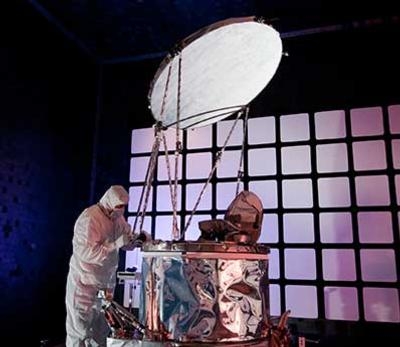
This new environmental satellite system leverages the Ball-built Global Precipitation Measurement (GPM) Microwave Imager (GMI) instrument, which is the on-orbit reference standard for calibrating precipitation measurements in NASA's GPM constellation. The WSF-M bus will be based on the Ball Configurable Platform, a proven, agile spacecraft with 50 years of on-orbit operations for affordable remote sensing applications.
Ball has played key roles on numerous national and international programs that make critical measurements of the physical environment. These include designing and building the weather spacecraft for both the recently launched Joint Polar Satellite System-1 (JPSS-1) and for the Suomi National Polar-orbiting Partnership (Suomi NPP).
(Source: Ball Aerospace news release. Image of GMI instrument provided)
More News
Convective SIGMET A weather advisory concerning convective weather significant to the safety of all aircraft. Convective SIGMETs are issued for tornadoes, lines of thunderstorms, e>[...]
Aero Linx: United Flying Octogenarians WELCOME to a most extraordinary group of aviators, the United Flying Octogenarians (UFO). Founded in 1982 with just a handful of pilots, we h>[...]
Pilot’s Decision To Attempt Takeoff With Frost Covering The Airplane’s Wings Analysis: The pilot of the light sport airplane was preparing to depart for a cross-country>[...]
“We’ve paid for the cable line’s repair for the customer and have apologized for the inconvenience this caused them...” Source: Some followup info from an A>[...]
Coupled Approach An instrument approach performed by the aircraft autopilot, and/or visually depicted on the flight director, which is receiving position information and/or steerin>[...]



 ANN's Daily Aero-Term (12.01.25): Convective SIGMET


 See All