
NASA Studies Cause of Orion Heat Shield Damage | Aero-News Network
Aero-News Network
RSS icon RSS feed
podcast icon MP3 podcast
Subscribe Aero-News e-mail Newsletter Subscribe

Airborne Unlimited -- Most Recent Daily Episodes

Episode Date

Airborne-Monday

Airborne-Tuesday

Airborne-Wednesday Airborne-Thursday

Airborne-Friday

Airborne On YouTube

Airborne-Unlimited-12.01.25

AirborneNextGen-
12.02.25

Airborne-Unlimited-12.03.25

Airborne-FltTraining-12.04.25

AirborneUnlimited-12.05.25

AFE 2025 LIVE MOSAIC Town Hall (Archived): www.airborne-live.net

Sun, Dec 08, 2024

NASA Studies Cause of Orion Heat Shield Damage

Agency Prepares For Launch of Crewed Artemis II Mission in 2025

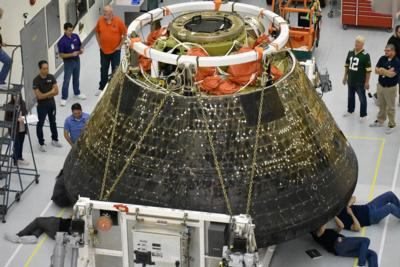
Through extensive testing, NASA has tracked down the root cause of Orion’s heat shield corrosion from the 2022 Artemis I mission. These findings aim to ensure safety for the crew of Artemis II, slated to launch in September 2025.

The uncrewed Orion spacecraft returned to Earth from the Artemis I mission in December 2022. In the following months, NASA revealed that there had been more “char loss” on Orion’s ablative heat shield than initially anticipated. While this did not endanger the capsule or its contents, the agency wanted to determine the cause of the damage before sending up a crewed spacecraft.

Over several months, the NASA engineering team took detailed samples of the Artemis heat shield, analyzed imagery and data from the spacecraft’s sensors, and conducted extensive ground testing. They also replicated Artemis I’s entry into the atmosphere.

When Orion was returning to Earth, it utilized the ‘skip guidance’ technique. It dipped into Earth’s atmosphere to slow down, then exited, then reentered with parachutes to splash down. 

The replication of these events allowed engineers to determine that the changing heating rate and thermal energy in the heat shield’s Avcoat material between dips caused cracking and separation on its surface.

“We took our heat shield investigation process extremely seriously with crew safety as the driving force behind the investigation,” explained Howard Hu, manager of the Orion Program at NASA’s Johnson Space Center. “The process was extensive. We gave the team the time needed to investigate every possible cause, and they worked tirelessly to ensure we understood the phenomenon and the necessary steps to mitigate this issue for future missions.”

Though Artemis I was an uncrewed mission, engineers assured that the heat shield damage would not have endangered astronauts on board. The cabin temperature held between 70 and 80 degrees Fahrenheit, putting it well within limits. This led NASA to decide that, with some changes to the entry method, the current Artemis II heat shield is more than capable of keeping a crew safe.

FMI: www.nasa.gov/artemis

Advertisement

More News

Aero-FAQ: Dave Juwel's Aviation Marketing Stories -- ITBOA BNITBOB

Dave Juwel's Aviation Marketing Stories ITBOA BNITBOB ... what does that mean? It's not gibberish, it's a lengthy acronym for "In The Business Of Aviation ... But Not In The Busine>[...]

NTSB Prelim: Rutan Long-EZ

The Pilot Attempted Several Times To Restart The Engine And Diverted To Long Beach Airport/Daughtery Field On October 20, 2025, about 1603 Pacific daylight time, an experimental am>[...]

ANN's Daily Aero-Term (12.05.25): Hazardous Weather Information

Hazardous Weather Information Summary of significant meteorological information (SIGMET/WS), convective significant meteorological information (convective SIGMET/WST), urgent pilot>[...]

Aero-News: Quote of the Day (12.05.25)

"The latest development underscores the government of Malaysia’s commitment in providing closure to the families affected by this tragedy..." Source: From statements made by >[...]

Airborne-Flight Training 12.04.25: Ldg Fee Danger, Av Mental Health, PC-7 MKX

Also: IAE Acquires Diamond Trainers, Army Drones, FedEx Pilots Warning, DA62 MPP To Dresden Tech Uni The danger to the flight training industry and our future pilots is clear. Dona>[...]

blog comments powered by Disqus



Advertisement

Advertisement

Podcasts

Advertisement

© 2007 - 2025 Web Development & Design by Pauli Systems, LC

