
College Editorial: TFRs Bad For GA, Small Businesses | Aero-News Network
Aero-News Network
RSS icon RSS feed
podcast icon MP3 podcast
Subscribe Aero-News e-mail Newsletter Subscribe

Airborne Unlimited -- Most Recent Daily Episodes

Episode Date

Airborne-Monday

Airborne-Tuesday

Airborne-Wednesday Airborne-Thursday

Airborne-Friday

Airborne On YouTube

Airborne-Unlimited-12.01.25

AirborneNextGen-
12.02.25

Airborne-Unlimited-11.19.25

Airborne-AffordableFlyers-11.20.25

AirborneUnlimited-11.21.25

LIVE MOSAIC Town Hall (Archived): www.airborne-live.net

Mon, Mar 04, 2013

College Editorial: TFRs Bad For GA, Small Businesses

Commentator Says FAA, Secret Service Focus On The Wrong Aircraft

Temporary flight restrictions designed to protect the President or put in place during major sporting events are targeted at exactly the wrong type of airplanes, according to a commentator writing recently in the UNLV Rebel Yell.

Dede Anderson writes in an op-ed piece in the paper that since the terrorist attacks of September 11th, 2001, GA airplanes have been prevented from flying or using certain airports when the President is nearby, while airliners are allowed to operate normally. But, it is pointed out, the 9/11 terrorists used airliners to bring down the World Trade Center and attack the Pentagon, not a Cessna 172 or balloon. The author said that the practice continues even after a federally-funded study pointing out that GA airplanes pose no credible threat to the security of the President, while airliners have that capacity.

But during a Presidential VIP TFR, GA and business airplanes sit idly on the ramp. Small businesses such as flight schools and helicopter tour operators can lose thousands of dollars per day, and many operate on a margin that makes such losses painful, if not devastating. There is never any compensation from the federal government for those losses.

But non-aviation businesses are affected as well. Small airplanes deliver things like lab results and critical replacement parts for manufacturing operations quickly and efficiently, except when they are not allowed to due to a TFR.

Anderson urges readers to contact members of their congressional delegations and express a concern about the effect of TFRs on small businesses. "The general aviation industry belongs to all of us," Dede writes, "and we need to protect it."

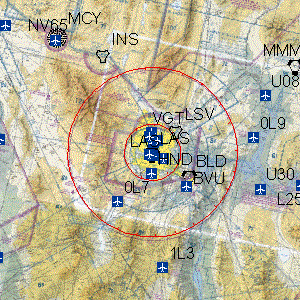
(Pictured: Recent TFR in place in Las Vegas during a visit by President Obama)

FMI: Full Article

Advertisement

More News

ANN's Daily Aero-Term (12.01.25): Convective SIGMET

Convective SIGMET A weather advisory concerning convective weather significant to the safety of all aircraft. Convective SIGMETs are issued for tornadoes, lines of thunderstorms, e>[...]

ANN's Daily Aero-Linx (12.01.25)

Aero Linx: United Flying Octogenarians WELCOME to a most extraordinary group of aviators, the United Flying Octogenarians (UFO). Founded in 1982 with just a handful of pilots, we h>[...]

NTSB Final Report: Remos Aircraft GmbH Remos GX

Pilot’s Decision To Attempt Takeoff With Frost Covering The Airplane’s Wings Analysis: The pilot of the light sport airplane was preparing to depart for a cross-country>[...]

Aero-News: Quote of the Day (12.02.25)

“We’ve paid for the cable line’s repair for the customer and have apologized for the inconvenience this caused them...” Source: Some followup info from an A>[...]

ANN's Daily Aero-Term (12.02.25): Coupled Approach

Coupled Approach An instrument approach performed by the aircraft autopilot, and/or visually depicted on the flight director, which is receiving position information and/or steerin>[...]

blog comments powered by Disqus



Advertisement

Advertisement

Podcasts

Advertisement

© 2007 - 2025 Web Development & Design by Pauli Systems, LC

