
Confirming A350 XWB Safety With Lightning Strike Evaluations | Aero-News Network
Aero-News Network
RSS icon RSS feed
podcast icon MP3 podcast
Subscribe Aero-News e-mail Newsletter Subscribe

Airborne Unlimited -- Most Recent Daily Episodes

Episode Date

Airborne-Monday

Airborne-Tuesday

Airborne-Wednesday Airborne-Thursday

Airborne-Friday

Airborne On YouTube

Airborne-Unlimited-12.01.25

AirborneNextGen-
12.02.25

Airborne-Unlimited-11.19.25

Airborne-AffordableFlyers-11.20.25

AirborneUnlimited-11.21.25

LIVE MOSAIC Town Hall (Archived): www.airborne-live.net

Fri, May 03, 2013

Confirming A350 XWB Safety With Lightning Strike Evaluations

Tests A Key Required Step In Preparations For This Next-Generation Airbus Jetliner's Maiden Flight

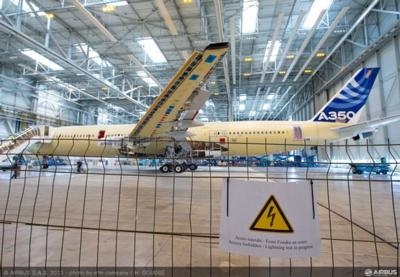
Lightning strike tests ... called “electromagnetic hazard” evaluations ... were conducted last month at Airbus’ Clément Ader facility in Colomiers, France. The tests involved the second A350 XWB flight test aircraft, MSN3, to demonstrate necessary protection levels in case of lightning strikes while aloft.

The A350 XWB’s aerostructure is made primarily of composite materials (carbon fiber reinforced plastic), providing more electrical resistance than an aerostructure consisting mostly of metallics. To ensure the A350 XWB aerostructure safely manages lightning strikes, Airbus developed a solution where metallic foils are embedded in the aircraft’s composite panels – increasing the aerostructure’s electrical conductivity and protecting harnesses with metallic conduits.
 
Metallic foils already have been used on the A380 rear fuselage section, however as the A350 XWB includes a higher percentage of composite materials, it is important to confirm that such foils provide adequate protection for systems and equipment.

The A350 XWB “electromagnetic hazard” testing on MSN3 lasted around three days, consisting of lightning strike simulations and follow-up measurements of induced voltage/current levels on selected harnesses. These evaluations use a low-level current injection rather than the actual electrical current level generated by a lightning strike, with the measured voltages and current then extrapolated to the real threat of 200,000 amperes.
 
This testing will be continued by similar but longer tests on the MSN4 aircraft in 2014, fulfilling a requirement for type certification of Airbus’ A350-900 version.

(Image provided by Airbus)

FMI: www.airbus.com

Advertisement

More News

ANN's Daily Aero-Term (11.29.25): Waypoint

Waypoint A predetermined geographical position used for route/instrument approach definition, progress reports, published VFR routes, visual reporting points or points for transiti>[...]

ANN's Daily Aero-Linx (11.29.25)

Aero Linx: Sentimental Journey to Cub Haven Sentimental Journey Flyin began in 1986 with a group of dedicated volunteers working to provide a sentimental return to Lock Haven, the >[...]

NTSB Prelim: Jabiru USA Sport Aircraft LLC J230-SP

The Pilot Would Often Fly Over Their House At A Low Altitude And That Family Members Would Go Outside To Wave On November 14, 2025, at 1708 eastern standard time, a Jabiru USA Spor>[...]

Classic Aero-TV: Crafting The Future of eVTOL Infrastructure

From 2024 (YouTube Edition): Volatus Infrastructure Paves The Way The name “Volatus” seems to be everywhere these days, popping up in a series of partnerships and proje>[...]

Klyde Morris (11.28.25)

Fortnite Conquers All, Klyde FMI: www.klydemorris.com>[...]

blog comments powered by Disqus



Advertisement

Advertisement

Podcasts

Advertisement

© 2007 - 2025 Web Development & Design by Pauli Systems, LC

