
Comet ISON May Have Survived | Aero-News Network
Aero-News Network
RSS icon RSS feed
podcast icon MP3 podcast
Subscribe Aero-News e-mail Newsletter Subscribe

Airborne Unlimited -- Most Recent Daily Episodes

Episode Date

Airborne-Monday

Airborne-Tuesday

Airborne-Wednesday Airborne-Thursday

Airborne-Friday

Airborne On YouTube

Airborne-Unlimited-12.01.25

AirborneNextGen-
12.02.25

Airborne-Unlimited-11.19.25

Airborne-AffordableFlyers-11.20.25

AirborneUnlimited-11.21.25

LIVE MOSAIC Town Hall (Archived): www.airborne-live.net

Tue, Dec 03, 2013

Comet ISON May Have Survived

Observed Emerging From The Far Side Of The Sun On Thanksgiving Day

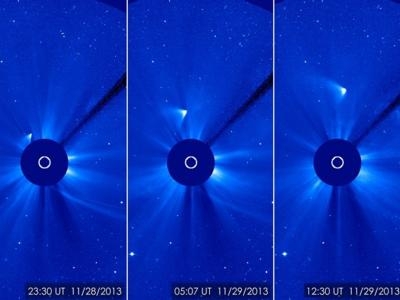
Continuing a history of surprising behavior, material from Comet ISON appeared on the other side of the sun on the evening on Nov. 28, 2013, despite not having been seen in observations during its closest approach to the sun.

As ISON appeared to dim and fizzle in several observatories and later could not be seen at all by NASA's Solar Dynamics Observatory or by ground based solar observatories, many scientists believed it had disintegrated completely. However, a streak of bright material streaming away from the sun appeared in the European Space Agency and NASA's Solar and Heliospheric Observatory later in the evening. The question remains whether it is merely debris from the comet, or if some portion of the comet's nucleus survived, but late-night analysis from scientists with NASA's Comet ISON Observing Campaign suggest that there is at least a small nucleus intact.

Throughout the year that researchers have watched Comet ISON – and especially during its final approach to the sun – the comet brightened and dimmed in unexpected ways.  Such brightness changes usually occur in response to material boiling off the comet, and different material will do so at different temperatures thus providing clues as to what the comet is made of.  Analyzing this pattern will help scientists understand the composition of ISON, which contains material assembled during the very formation of the solar system some 4.5 billion years ago.

(Image provided by NASA)

FMI: www.nasa.gov

Advertisement

More News

ANN's Daily Aero-Term (11.29.25): Waypoint

Waypoint A predetermined geographical position used for route/instrument approach definition, progress reports, published VFR routes, visual reporting points or points for transiti>[...]

ANN's Daily Aero-Linx (11.29.25)

Aero Linx: Sentimental Journey to Cub Haven Sentimental Journey Flyin began in 1986 with a group of dedicated volunteers working to provide a sentimental return to Lock Haven, the >[...]

NTSB Prelim: Jabiru USA Sport Aircraft LLC J230-SP

The Pilot Would Often Fly Over Their House At A Low Altitude And That Family Members Would Go Outside To Wave On November 14, 2025, at 1708 eastern standard time, a Jabiru USA Spor>[...]

Classic Aero-TV: Crafting The Future of eVTOL Infrastructure

From 2024 (YouTube Edition): Volatus Infrastructure Paves The Way The name “Volatus” seems to be everywhere these days, popping up in a series of partnerships and proje>[...]

Klyde Morris (11.28.25)

Fortnite Conquers All, Klyde FMI: www.klydemorris.com>[...]

blog comments powered by Disqus



Advertisement

Advertisement

Podcasts

Advertisement

© 2007 - 2025 Web Development & Design by Pauli Systems, LC

