Fri, Sep 03, 2010
Four Electric Motors, Lithium Batteries Power Tiny
Airplane
The all electric Cri-Cri, jointly developed by EADS Innovation
Works, Aero Composites Saintonge and the Green Cri-Cri Association,
made its official maiden flight at Le Bourget airport near Paris
Thursday. This Cri-Cri is the first-ever four-engined all-electric
aerobatic plane, which was first shown at the Green Aviation Show
at Le Bourget in June.
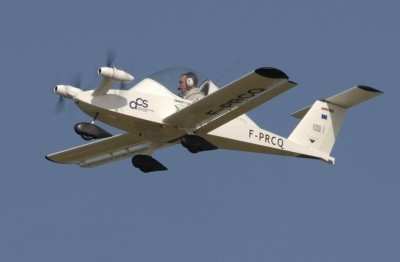
Cri-Cri In Flight
The plane became airborne at 1112 CET. Test pilot Didier Esteyne
said take-off and climb were smooth, no vibrations could be felt
and maneuverability was excellent. All systems performed well and
the plane returned safely after 7 minutes. “This aircraft
flies very smoothly, much more quietly than a plane with
conventional propulsion”, said Esteyne. “But we are
still at the beginning and have a lot to learn. We are allowed to
start aerobatic maneuvers only after five hours of flight and 15
landings.”
“The Cri-Cri is a low-cost test bed for system integration
of electrical technologies in support of projects like our hybrid
propulsion concept for helicopters,” stated Jean Botti,
EADS’s Chief Technical Officer. “We hope to get a lot
of useful information out of this project.” In the near
future batteries will be available to propel larger
aircraft.
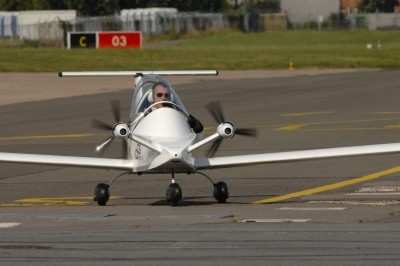
The aerobatic plane incorporates numerous innovative
technologies such as lightweight composite structures that reduce
the weight of the airframe and compensate for the additional weight
of the batteries, four brushless electric motors with
counter-rotating propellers which deliver propulsion without CO2
emissions and significantly lower noise compared to thermal
propulsion, and high energy-density Lithium batteries. The combined
utilization of these environment-friendly technical innovations
enables the Cri-Cri to deliver 30 minutes of autonomous
cruise flight at about 60 knots, or 15 minutes of autonomous
aerobatics at speeds reaching up to 135 knots, and a climb rate of
approximately 1,000 fpm.
More News
Waypoint A predetermined geographical position used for route/instrument approach definition, progress reports, published VFR routes, visual reporting points or points for transiti>[...]
Aero Linx: Sentimental Journey to Cub Haven Sentimental Journey Flyin began in 1986 with a group of dedicated volunteers working to provide a sentimental return to Lock Haven, the >[...]
The Pilot Would Often Fly Over Their House At A Low Altitude And That Family Members Would Go Outside To Wave On November 14, 2025, at 1708 eastern standard time, a Jabiru USA Spor>[...]
From 2024 (YouTube Edition): Volatus Infrastructure Paves The Way The name “Volatus” seems to be everywhere these days, popping up in a series of partnerships and proje>[...]
Fortnite Conquers All, Klyde FMI: www.klydemorris.com>[...]



 ANN's Daily Aero-Term (11.29.25): Waypoint


 See All