
NASA Conducts First Test Of Ares I Main Parachute | Aero-News Network
Aero-News Network
RSS icon RSS feed
podcast icon MP3 podcast
Subscribe Aero-News e-mail Newsletter Subscribe

Airborne Unlimited -- Most Recent Daily Episodes

Episode Date

Airborne-Monday

Airborne-Tuesday

Airborne-Wednesday Airborne-Thursday

Airborne-Friday

Airborne On YouTube

Airborne-Unlimited-12.01.25

AirborneNextGen-
12.02.25

Airborne-Unlimited-11.19.25

Airborne-AffordableFlyers-11.20.25

AirborneUnlimited-11.21.25

LIVE MOSAIC Town Hall (Archived): www.airborne-live.net

Wed, Oct 03, 2007

NASA Conducts First Test Of Ares I Main Parachute

Successfully Returns 17,500-Lb Payload To Earth

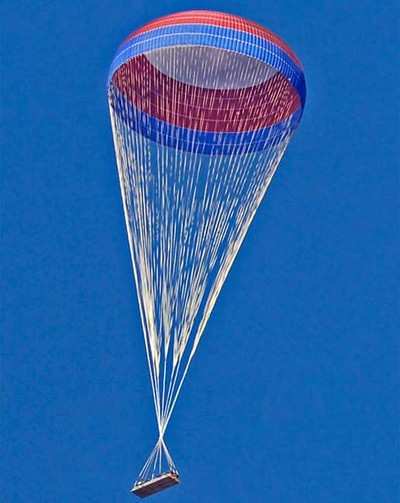
The pieces of Orion continue to come together. Last month, NASA and industry engineers successfully completed the first drop test of the main parachute that will help recover the first stage of the Ares I crew launch vehicle.

Ares I will carry NASA's Orion crew exploration vehicle to space.

The test -- conducted on September 25 at the US Army's Yuma Proving Ground near Yuma, AX -- is part of an ongoing series of tests to support the design and development of the Ares I parachute recovery system, which is derived from the system NASA uses to recover the space shuttle's solid rocket boosters after launch.

Tests for the pilot, drogue and three main parachutes will continue through 2010. The next test is scheduled for November of this year.

The main parachute was dropped from a US Air Force C-17 aircraft with a 40,600-pound load at an altitude of 17,500 feet. The parachute and all test hardware functioned properly, and landed safely on the Yuma Proving Ground test range.

NASA's Marshall Space Flight Center in Huntsville, AL manages the Ares Project and leads the design and development of the solid rocket booster recovery system. ATK Launch Systems near Brigham City, UT is the prime contractor for the first stage booster.

ATK's subcontractor, United Space Alliance of Houston, is designing, developing and testing the parachutes at its facilities at NASA's Kennedy Space Center in Florida. NASA's Johnson Space Center in Houston hosts the Constellation Program and Orion Project Office and provides test instrumentation and support personnel.

FMI: www.nasa.gov/constellation

Advertisement

More News

ANN's Daily Aero-Term (11.29.25): Waypoint

Waypoint A predetermined geographical position used for route/instrument approach definition, progress reports, published VFR routes, visual reporting points or points for transiti>[...]

ANN's Daily Aero-Linx (11.29.25)

Aero Linx: Sentimental Journey to Cub Haven Sentimental Journey Flyin began in 1986 with a group of dedicated volunteers working to provide a sentimental return to Lock Haven, the >[...]

NTSB Prelim: Jabiru USA Sport Aircraft LLC J230-SP

The Pilot Would Often Fly Over Their House At A Low Altitude And That Family Members Would Go Outside To Wave On November 14, 2025, at 1708 eastern standard time, a Jabiru USA Spor>[...]

Classic Aero-TV: Crafting The Future of eVTOL Infrastructure

From 2024 (YouTube Edition): Volatus Infrastructure Paves The Way The name “Volatus” seems to be everywhere these days, popping up in a series of partnerships and proje>[...]

Klyde Morris (11.28.25)

Fortnite Conquers All, Klyde FMI: www.klydemorris.com>[...]

blog comments powered by Disqus



Advertisement

Advertisement

Podcasts

Advertisement

© 2007 - 2025 Web Development & Design by Pauli Systems, LC

