

NASA Still Debating Orion Touchdown Scenarios | Aero-News Network
Aero-News Network
RSS icon RSS feed
podcast icon MP3 podcast
Subscribe Aero-News e-mail Newsletter Subscribe

Airborne Unlimited -- Most Recent Daily Episodes

Episode Date

Airborne-Monday

Airborne-Tuesday

Airborne-Wednesday Airborne-Thursday

Airborne-Friday

Airborne On YouTube

Airborne-Unlimited-12.08.25

AirborneNextGen-
12.09.25

Airborne-Unlimited-12.10.25

Airborne-AffordableFlyers-12.11.25

AirborneUnlimited-12.12.25

AFE 2025 LIVE MOSAIC Town Hall (Archived): www.airborne-live.net

Wed, Dec 12, 2007

NASA Still Debating Orion Touchdown Scenarios

Land, Or Water?

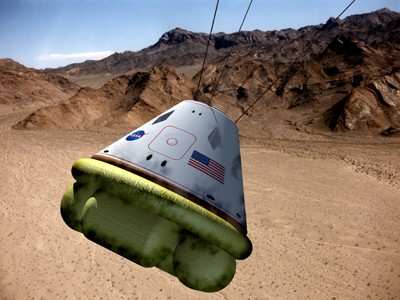
We've been hearing for quite awhile about NASA's Orion space capsule, and how it will replace the retiring space shuttle fleet in the next decade. But despite all the work done to date, one major design issue has yet to be resolved...

Will Orion return to earth using the splashdown technique used by early US manned space capsules... or over land, as pioneered by the former Soviet Union?

One thing is for sure...Orion will use a parachute, and will not have wheeled landing gear. This means a land-based recovery would need to be on the money every time, or impose serious risks to both astronauts and residents on the ground. It would also require enormous airbags, which is 1,500 pounds NASA would prefer not to require in its weight budget.

"There are a couple of aspects that pop out at us," Jeff Hanley, Manager for the Constellation Program, told Universe Today. "One is the safety and the risks involved in landing. Looking at the landing itself, the event of actually touching down, water comes out to be preferable as less risk... [but] in looking at what it takes to get a pound of spacecraft to low lunar orbit in terms of the cost, every pound that you send toward the moon is precious.

"From an efficiency and performance point of view, carrying 1500 lbs of landing bags to the moon and back when we have a perfectly viable mode of landing in the water near a US coastal site didn’t seem like a good trade in performance," Hanley added. "We’ve tended toward updating our point of departure concept to now be a nominal US coastal water landing."

A splashdown in the ocean would make precision in hitting the target less critical, but it would also subject the craft to saltwater... which is problematic for a vehicle intended to be at least partially reuseable.

Hanley told The Orlando Sentinel costs for the two methods would be comparable, and that NASA engineers reach a decision as soon as sometime next year. The first mission of the Constellation program is set for 2015.

FMI: www.nasa.gov/mission_pages/constellation/orion/

Advertisement

More News

Aero-News: Quote of the Day (12.11.25)

"The owners envisioned something modern and distinctive, yet deeply meaningful. We collaborated closely to refine the flag design so it complemented the aircraft’s contours w>[...]

ANN's Daily Aero-Term (12.11.25): Nonradar Arrival

Nonradar Arrival An aircraft arriving at an airport without radar service or at an airport served by a radar facility and radar contact has not been established or has been termina>[...]

Classic Aero-TV: David Uhl and the Lofty Art of Aircraft Portraiture

From 2022 (YouTube Edition): Still Life with Verve David Uhl was born into a family of engineers and artists—a backdrop conducive to his gleaning a keen appreciation for the >[...]

Airborne-NextGen 12.09.25: Amazon Crash, China Rocket Accident, UAV Black Hawk

Also: Electra Goes Military, Miami Air Taxi, Hypersonics Lab, MagniX HeliStrom Amazon’s Prime Air drones are back in the spotlight after one of its newest MK30 delivery drone>[...]

Airborne 12.05.25: Thunderbird Ejects, Lost Air india 737, Dynon Update

Also: Trailblazing Aviator Betty Stewart, Wind Farm Scrutiny, Chatham Ban Overturned, Airbus Shares Dive A Thunderbird pilot, ID'ed alternately as Thunderbird 5 or Thunderbird 6, (>[...]

blog comments powered by Disqus



Advertisement

Advertisement

Podcasts

Advertisement

© 2007 - 2025 Web Development & Design by Pauli Systems, LC

