
NASA's Deep Impact Probe Aims Telescope At Alien Planets | Aero-News Network
Aero-News Network
RSS icon RSS feed
podcast icon MP3 podcast
Subscribe Aero-News e-mail Newsletter Subscribe

Airborne Unlimited -- Most Recent Daily Episodes

Episode Date

Airborne-Monday

Airborne-Tuesday

Airborne-Wednesday Airborne-Thursday

Airborne-Friday

Airborne On YouTube

Airborne-Unlimited-12.01.25

AirborneNextGen-
12.02.25

Airborne-Unlimited-11.19.25

Airborne-AffordableFlyers-11.20.25

AirborneUnlimited-11.21.25

LIVE MOSAIC Town Hall (Archived): www.airborne-live.net

Tue, Jun 03, 2008

NASA's Deep Impact Probe Aims Telescope At Alien Planets

Begins Extended Epoxi Mission En Route to Hartley 2

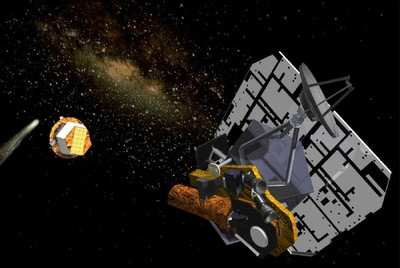
NASA's Deep Impact spacecraft is aiming its largest telescope at five stars in a search for alien (exosolar) planets as it enters its extended mission, called Epoxi.

Deep Impact made history when the mission team directed an impactor from the spacecraft into comet Tempel 1 on July 4, 2005. As ANN reported, NASA recently extended the mission, redirecting the spacecraft for a flyby of comet Hartley 2 on October 11, 2010.

As it cruises toward the comet, Deep Impact will observe five nearby stars with "transiting exosolar planets," so named because the planet transits, or passes in front of, its star. The Epoxi team, led by University of Maryland astronomer Michael A'Hearn, directed the spacecraft to begin these observations January 22. The planets were discovered earlier and are giant planets with massive atmospheres, like Jupiter in our solar system. They orbit their stars much closer than Earth does the sun, so they are hot and belong to the class of exosolar planets nicknamed "Hot Jupiters."

However, these giant planets may not be alone. If there are other worlds around these stars, they might also transit the star and be discovered by the spacecraft. Deep Impact can even find planets that don't transit, using a timing technique. Gravity from the unseen planets will pull on the transiting planets, altering their orbits and the timing of their transits.

"We're on the hunt for planets down to the size of Earth, orbiting some of our closest neighboring stars," said Epoxi Deputy Principal Investigator Drake Deming of NASA's Goddard Space Flight Center in Greenbelt, MD. Epoxi is a combination of the names for the two extended mission components: the exosolar planet observations, called Extrasolar Planet Observations and Characterization (Epoch), and the flyby of comet Hartley 2, called the Deep Impact Extended Investigation (Dixi). Goddard leads the Epoch component.

More than 200 exosolar planets have been discovered to date. Most of these are detected indirectly, by the gravitational pull they exert on their parent star. Directly observing exosolar planets by detecting the light reflected from them is very difficult, because a star's brilliance obscures light coming from any planets orbiting it.

However, sometimes the orbit of an exosolar world is aligned so that it eclipses its star as seen from Earth. In these rare cases, called transits, light from that planet can be seen directly.

"When the planet appears next to its star, your telescope captures their combined light. When the planet passes behind its star, your telescope only sees light from the star. By subtracting light from just the star from the combined light, you are left with light from the planet," said Deming, who is leading the search for exosolar worlds with Deep Impact. "We can analyze this light to discover what the atmospheres of these planets are like."

FMI: www.nasa.gov

Advertisement

More News

NTSB Prelim: Cirrus Design Corp SR20

The Airplane Made An Uncommanded Right Yaw And Roll, And He Was Unable To Maintain Control Of The Airplane On November 11, 2025, about 1750 central standard time, a Cirrus SR20, N8>[...]

ANN's Daily Aero-Linx (11.30.25)

Aero Linx: Florida Antique Biplane Association "Biplanes.....outrageous fun since 1903." That quote really defines what the Florida Antique Biplane Association (FABA) is all about.>[...]

ANN's Daily Aero-Term (11.30.25): Wind Shear Escape

Wind Shear Escape An unplanned abortive maneuver initiated by the pilot in command (PIC) as a result of onboard cockpit systems. Wind shear escapes are characterized by maximum thr>[...]

Aero-News: Quote of the Day (11.30.25)

“Working closely with the Polish Armed Forces, we’re focused on disciplined execution to help enhance Poland’s defense capabilities and keep up with the strong de>[...]

Airborne 11.26.25: Bonanza-Baron Fini, Archer v LA NIMBYs, Gogo Loses$$$

Also: Bell 505 on SAF, NYPA Gets Flak For BizAv 'Abuse', FAA Venezuela Caution, Horizon Update Textron Aviation has confirmed it will be ending production of the Beechcraft Bonanza>[...]

blog comments powered by Disqus



Advertisement

Advertisement

Podcasts

Advertisement

© 2007 - 2025 Web Development & Design by Pauli Systems, LC

