Wed, Jul 05, 2017
Could Provide Communications Support In Disaster Zones
Engineers at MIT have developed a drone that can stay aloft for up to five days, according to the university.
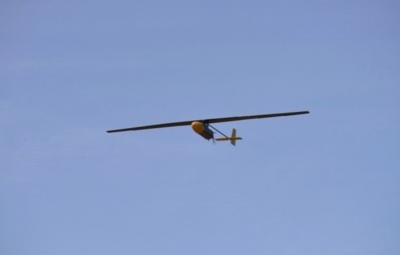
The design team says that the aircraft can loiter over areas and provide long duration communications support in times of natural or other disasters. The researchers designed, built, and tested a UAV resembling a thin glider with a 24-foot wingspan. The vehicle can carry 10 to 20 pounds of communications equipment while flying at an altitude of 15,000 feet. Weighing in at just under 150 pounds, the vehicle is powered by a 5-horsepower gasoline engine and can keep itself aloft for more than five days — longer than any gasoline-powered autonomous aircraft has remained in flight, the researchers say.
The drone was developed as part of the Beaver Works capstone project at MIT. Beaver Works was approached by the USAF in 2016 and asked to develop a solar-powered drone for such missions. But the team found when analyzing the problem from multiple engineering angles that solar power was not always the best solution. R. John Hansman, the T. Wilson Professor of Aeronautics and Astronautics, said that while solar was fine in the summer months, "in winter, particularly if you’re far from the equator, nights are longer, and there’s not as much sunlight during the day. So you have to carry more batteries, which adds weight and makes the plane bigger. For the mission of disaster relief, this could only respond to disasters that occur in summer, at low latitude. That just doesn’t work.”
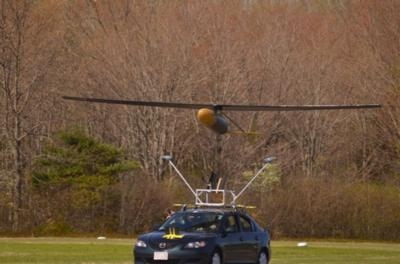
The team developed a design that computer models suggested would be able to fly for up to five days at altitudes of up to 15,000 feet in up to 94th percentile winds at any latitude.
The aircraft was tested in May at Plum Island Airport in Newburyport, MA. It successfully took off, flew and landed safely.
While the five-day duration has not been proven, Warren Hoburg, the Boeing Assistant Professor of Aeronautics and Astronautics said that the team is "pretty confident that we have the right fuel burn rate and right engine that we could fly it for five days.”
(Images provided by MIT)
More News
From 2023 (YouTube Edition): New Propulsion Scheme Optimized for AAM Applications Founded in 2017 by Eric Bartsch, Pat Anderson, and Erik Lindbergh (grandson of famed aviation pion>[...]
During The Initial Climb, The Engine Began To Operate Abnormally And, After About Three Seconds, Experienced A Total Loss Of Power On October 29, 2025, about 1820 Pacific daylight >[...]
Aero Linx: Women in Aviation International Women in Aviation International is the largest nonprofit organization that envisions a world where the sky is open to all, and where avia>[...]
“We’ve paid for the cable line’s repair for the customer and have apologized for the inconvenience this caused them...” Source: Some followup info from an A>[...]
“We have long warned about the devastating effects of pairing optimization. Multiple times over many months, we highlighted how schedule manipulation, unbalanced schedules, a>[...]



 Classic Aero-TV: VerdeGo Debuts VH-3 Hybrid-Electric Powerplant


 See All