
NASA Telescopes Take A Close Look At The Brightest Comet Of 2018 | Aero-News Network
Aero-News Network
RSS icon RSS feed
podcast icon MP3 podcast
Subscribe Aero-News e-mail Newsletter Subscribe

Airborne Unlimited -- Most Recent Daily Episodes

Episode Date

Airborne-Monday

Airborne-Tuesday

Airborne-Wednesday Airborne-Thursday

Airborne-Friday

Airborne On YouTube

Airborne-Unlimited-12.01.25

AirborneNextGen-
12.02.25

Airborne-Unlimited-12.03.25

Airborne-AffordableFlyers-11.20.25

AirborneUnlimited-11.21.25

LIVE MOSAIC Town Hall (Archived): www.airborne-live.net

Sat, Jan 05, 2019

NASA Telescopes Take A Close Look At The Brightest Comet Of 2018

Images Captured When The Comet Was 7.4 Million Miles From Earth

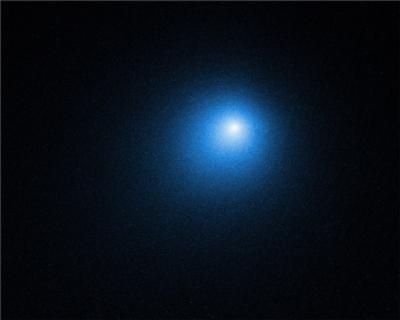
As the brilliant comet 46P/Wirtanen streaked across the sky, NASA telescopes caught it on camera from multiple angles.

NASA’s Hubble Space Telescope photographed comet 46P/Wirtanen on Dec. 13, when the comet was 7.4 million miles from Earth. In this visible-light image, the comet’s nucleus is hidden in the center of a fuzzy glow from the comet’s coma. The coma is a cloud of gas and dust that the comet has ejected during its pass through the inner solar system due to heating from the Sun. To make this composite image, the color blue was applied to high-resolution grayscale exposures acquired from the spacecraft’s Wide Field Camera 3 (WFC3) instrument.

The inner part of a comet’s coma is normally not accessible from Earth. The close flyby of comet 46P/Wirtanen allowed astronomers to study it in detail. They combined the unique capabilities of Hubble, NASA’s Chandra X-ray Observatory and the Neil Gehrels Swift Observatory to study how gases are released from the nucleus, what the comet’s ices are composed of, and how gas in the coma is chemically altered by sunlight and solar radiation.

Comets and asteroids may be the source of Earth’s water. SOFIA is studying the chemical fingerprints of different types of hydrogen in the comet’s water, which will help us learn about the origins and history of water in the solar system — including Earth’s oceans. The SOFIA image was taken with the telescope's visible-light guide camera, using an orange filter to indicate the intensity of light relative to other objects. SOFIA's observations using infrared light to study the comet's water are now under analysis.

Comet 46P/Wirtanen made its closest approach to Earth on Dec. 16, when it passed just over 7 million miles from our planet, about 30 times farther away than the Moon. Although its close approach is valuable for making science observations from Earth, and it is the brightest comet of 2018, 46P/Wirtanen is only barely visible to the unaided eye even where the sky is very dark. It is best viewed through binoculars or a telescope.

Backyard observers can currently find the comet near the constellation Taurus though with the challenge of added light from the Moon, but it will continue to be viewable in the weeks to come. Finder charts and other information are available at the Comet Wirtanen Observing Campaign website.

Comet 46P/Wirtanen orbits the Sun once every 5.4 years, much quicker than the 75-year orbit of the more famous comet Halley. Most of its passes through the inner solar system are much farther from Earth, making this year’s display particularly notable.

(Image provided with NASA news release)

FMI: www.nasa.gov

Advertisement

More News

Classic Aero-TV: VerdeGo Debuts VH-3 Hybrid-Electric Powerplant

From 2023 (YouTube Edition): New Propulsion Scheme Optimized for AAM Applications Founded in 2017 by Eric Bartsch, Pat Anderson, and Erik Lindbergh (grandson of famed aviation pion>[...]

NTSB Prelim: Grumman American Avn. Corp. AA-5B

During The Initial Climb, The Engine Began To Operate Abnormally And, After About Three Seconds, Experienced A Total Loss Of Power On October 29, 2025, about 1820 Pacific daylight >[...]

ANN's Daily Aero-Linx (12.02.25)

Aero Linx: Women in Aviation International Women in Aviation International is the largest nonprofit organization that envisions a world where the sky is open to all, and where avia>[...]

Aero-News: Quote of the Day (12.02.25)

“We’ve paid for the cable line’s repair for the customer and have apologized for the inconvenience this caused them...” Source: Some followup info from an A>[...]

Aero-News: Quote of the Day (12.03.25)

“We have long warned about the devastating effects of pairing optimization. Multiple times over many months, we highlighted how schedule manipulation, unbalanced schedules, a>[...]

blog comments powered by Disqus



Advertisement

Advertisement

Podcasts

Advertisement

© 2007 - 2025 Web Development & Design by Pauli Systems, LC

