
NASA Armstrong Celebrates 50th Anniversary Of LLRV First Flight | Aero-News Network
Aero-News Network
RSS icon RSS feed
podcast icon MP3 podcast
Subscribe Aero-News e-mail Newsletter Subscribe

Airborne Unlimited -- Most Recent Daily Episodes

Episode Date

Airborne-Monday

Airborne-Tuesday

Airborne-Wednesday Airborne-Thursday

Airborne-Friday

Airborne On YouTube

Airborne-Unlimited-12.01.25

AirborneNextGen-
12.02.25

Airborne-Unlimited-12.03.25

Airborne-AffordableFlyers-11.20.25

AirborneUnlimited-11.21.25

LIVE MOSAIC Town Hall (Archived): www.airborne-live.net

Wed, Nov 05, 2014

NASA Armstrong Celebrates 50th Anniversary Of LLRV First Flight

The 'Flying Bedstead' Trained Astronauts For Lunar Landing

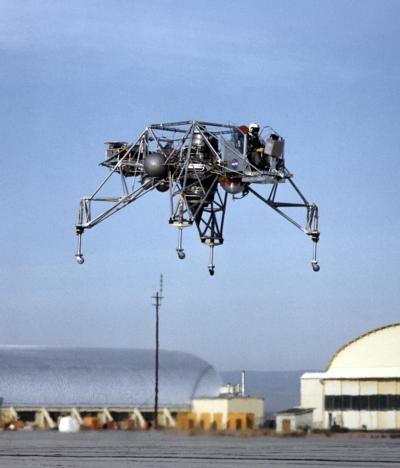
Before the Apollo astronauts landed on the moon, they first had to practice on Earth. A colloquium at NASA Armstrong Flight Research Center on Oct. 29 marked the 50th anniversary of the first flight of a most unusual vehicle that was used to train the first humans to visit another world – the Lunar Landing Research Vehicle, or LLRV. Guest speakers included former project manager Gene Matranga, engineer Wayne Ottinger, pilot Donald Mallick, and Rocket Shop supervisor Dave Stoddard. Other original LLRV team members present included Glenn Angle and Adam Mello.

In the early 1960s, NASA studied several techniques for simulating descent to the lunar surface. Electronic simulators and a tethered mockup provided valuable training but only a free-flying vehicle could provide a truly high-fidelity simulation. Hubert Drake at NASA’s Flight Research Center (known today as the Armstrong Flight Research Center) conceived a concept that became the LLRV.

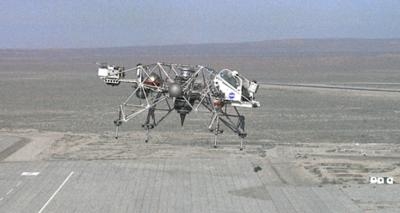
Built of aluminum alloy trusses and shaped like a giant four-legged bedstead, the vehicle simulated a lunar landing profile with the help of a 4,200-pound-thrust turbofan engine mounted vertically in a gimbal. Upon reaching the maximum test altitude, the pilot then throttled back until the jet supported just five-sixths of the vehicle's weight, simulating the moon’s reduced gravity. Two variable-thrust hydrogen peroxide rockets controlled the LLRV's rate of descent and horizontal movement. Sixteen smaller hydrogen peroxide thrusters gave the pilot control in pitch, yaw, and roll.

For the initial flights on Oct. 30, 1964, research pilot Joe Walker flew the LLRV three times for a total of just under 60 seconds, reaching a modest peak altitude of 10 feet. Later flights were shared between Walker; Donald Mallick; the Army's Jack Kleuver; and Joseph Algranti and H.E. "Bud" Ream of NASA’s Manned Spacecraft Center (now the Johnson Space Center) in Houston, Texas.

The first LLRV was shipped to Houston in December 1966, followed a month later by its nearly identical twin. Three slightly larger craft joined the training fleet, and all were re-designated Lunar Landing Training Vehicles. Three of the five were later destroyed in non-fatal accidents. Fittingly, the two surviving vehicles are currently displayed at Armstrong and Johnson.

All prime and backup commanders assigned to Apollo lunar landing missions practiced in the craft and later acknowledged the benefits. Apollo 11 astronaut Neil Armstrong, first human to step onto the moon's surface, said the mission would not have been successful without the quality of simulation that resulted from the LLRV's. Other astronauts echoed these feelings.

(Images provided by NASA)

FMI: www.nasa.gov

Advertisement

More News

Classic Aero-TV: VerdeGo Debuts VH-3 Hybrid-Electric Powerplant

From 2023 (YouTube Edition): New Propulsion Scheme Optimized for AAM Applications Founded in 2017 by Eric Bartsch, Pat Anderson, and Erik Lindbergh (grandson of famed aviation pion>[...]

NTSB Prelim: Grumman American Avn. Corp. AA-5B

During The Initial Climb, The Engine Began To Operate Abnormally And, After About Three Seconds, Experienced A Total Loss Of Power On October 29, 2025, about 1820 Pacific daylight >[...]

ANN's Daily Aero-Linx (12.02.25)

Aero Linx: Women in Aviation International Women in Aviation International is the largest nonprofit organization that envisions a world where the sky is open to all, and where avia>[...]

Aero-News: Quote of the Day (12.02.25)

“We’ve paid for the cable line’s repair for the customer and have apologized for the inconvenience this caused them...” Source: Some followup info from an A>[...]

Aero-News: Quote of the Day (12.03.25)

“We have long warned about the devastating effects of pairing optimization. Multiple times over many months, we highlighted how schedule manipulation, unbalanced schedules, a>[...]

blog comments powered by Disqus



Advertisement

Advertisement

Podcasts

Advertisement

© 2007 - 2025 Web Development & Design by Pauli Systems, LC

