


NASA Wallops Launches Terrier-Improved Orion Suborbital Sounding Rocket | Aero-News Network
Aero-News Network
RSS icon RSS feed
podcast icon MP3 podcast
Subscribe Aero-News e-mail Newsletter Subscribe

Airborne Unlimited -- Most Recent Daily Episodes

Episode Date

Airborne-Monday

Airborne-Tuesday

Airborne-Wednesday Airborne-Thursday

Airborne-Friday

Airborne On YouTube

Airborne-Unlimited-12.08.25

AirborneNextGen-
12.09.25

Airborne-Unlimited-12.10.25

Airborne-AffordableFlyers-12.11.25

AirborneUnlimited-12.12.25

AFE 2025 LIVE MOSAIC Town Hall (Archived): www.airborne-live.net

Sun, Jun 12, 2011

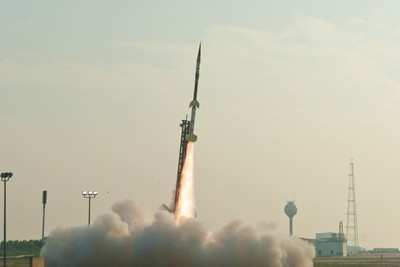
NASA Wallops Launches Terrier-Improved Orion Suborbital Sounding Rocket

If At First You Don't Succeed.. Launch, Launch Again

It took a few tries, but the launch of a NASA Terrier-Improved Orion suborbital rocket was successfully conducted at 7:16 a.m. EDT, Friday, from NASA’s Wallops Flight Facility in Virginia. The launch was to test several new rocket and spacecraft technologies including the Small Rocket/Spacecraft Technology (SMART) platform, Autonomous Flight Safety System, Low Cost Telemetry Transmitter, and an electro hydrodynamic-based thermal control unit.

Rescheduled after a launch abort that occurred the day before, the launch team determined that a misfire occurred because of a short circuit in the ground electrical support system. The rocket and the payload were undamaged by the short circuit and the ground support system repaired the issue.

The Small Rocket/Spacecraft Technology (SMART) platform, created by engineers at the Goddard Space Flight Center, Greenbelt, Md., and the Department of Defense Operationally Responsive Space (ORS) Office at the Kirtland Air Force Base in New Mexico, is designed to provide faster, less expensive access to space because of its modular, reconfigurable design. Users can adapt SMART to fulfill a variety of missions ranging from optical imaging to radio-frequency applications.

Comparable in size to an old-fashioned hatbox, measuring nearly 16 inches in diameter, the SMART microsatellite can be integrated and readied for launch in as few as seven days for less than $1 million, said Goddard engineer Jaime Esper, platform designer.

“We’ve developed a creative way to reduce mission life-cycle times, with the resulting savings in cost. This enables a new class of researchers who can’t afford the high costs of getting into space.”

Another emerging new technology installed on SMART is an electro hydrodynamic-based thermal control unit. The technology uses electric fields to pump coolant through tiny ducts inside a thermal cold plate. The advantage is that the system requires no moving parts, just electrodes to apply the voltage to move the coolant.

The next launch currently scheduled from Wallops is a NASA Terrier-Improved Orion carrying educational experiments. The launch window is June 23 – 25 between 6 and 9 a.m.

FMI: www.nasa.gov/wallops

Advertisement

More News

Aero-News: Quote of the Day (12.11.25)

"The owners envisioned something modern and distinctive, yet deeply meaningful. We collaborated closely to refine the flag design so it complemented the aircraft’s contours w>[...]

ANN's Daily Aero-Term (12.11.25): Nonradar Arrival

Nonradar Arrival An aircraft arriving at an airport without radar service or at an airport served by a radar facility and radar contact has not been established or has been termina>[...]

Classic Aero-TV: David Uhl and the Lofty Art of Aircraft Portraiture

From 2022 (YouTube Edition): Still Life with Verve David Uhl was born into a family of engineers and artists—a backdrop conducive to his gleaning a keen appreciation for the >[...]

Airborne-NextGen 12.09.25: Amazon Crash, China Rocket Accident, UAV Black Hawk

Also: Electra Goes Military, Miami Air Taxi, Hypersonics Lab, MagniX HeliStrom Amazon’s Prime Air drones are back in the spotlight after one of its newest MK30 delivery drone>[...]

Airborne 12.05.25: Thunderbird Ejects, Lost Air india 737, Dynon Update

Also: Trailblazing Aviator Betty Stewart, Wind Farm Scrutiny, Chatham Ban Overturned, Airbus Shares Dive A Thunderbird pilot, ID'ed alternately as Thunderbird 5 or Thunderbird 6, (>[...]

blog comments powered by Disqus



Advertisement

Advertisement

Podcasts

Advertisement

© 2007 - 2025 Web Development & Design by Pauli Systems, LC

