Wed, Jun 05, 2013
Completes Wind Tunnel Testing Of CTS-100 Spacecraft, Atlas V Rocket
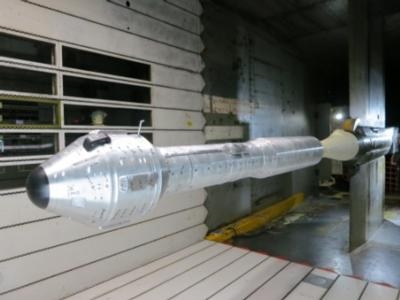
The Boeing Company of Houston, a NASA Commercial Crew Program (CCP) partner, recently performed wind tunnel testing of its CST-100 spacecraft and integrated launch vehicle, the United Launch Alliance (ULA) Atlas V rocket. The testing is part of NASA's Commercial Crew Integrated Capability (CCiCap) initiative, intended to make commercial human spaceflight services available for government and commercial customers.
Boeing and ULA also worked together to test a newly developed component of the Atlas V's Centaur upper stage. Boeing now has completed two of eight performance milestones under CCiCap and is on track to complete all 19 of its milestones around mid-2014. "The Centaur has a long and storied past of launching the agency's most successful spacecraft to other worlds," said Ed Mango, NASA's CCP manager at the agency's Kennedy Space Center in Florida. "Because it has never been used for human spaceflight before, these tests are critical to ensuring a smooth and safe performance for the crew members who will be riding atop the human-rated Atlas V."
The wind tunnel tests, which began in March and wrapped up in May at NASA's Ames Research Center in Moffett Field, CA, were the first interface tests of Boeing's spacecraft, launch vehicle adaptor and launch vehicle. A scale model of the integrated spacecraft and rocket was placed in Ames' 11-foot diameter transonic wind tunnel. The data gathered provides Boeing with critical information it needs to ensure its system is safe for launching crews to low-Earth orbit.
The Centaur liquid oxygen-feed duct line was tested in March in Murrieta, CA, to characterize how liquid oxygen moves from the stage's oxygen tank to its two engines where the propellant will be mixed with liquid hydrogen to create thrust. The Centaur, which takes over after the Atlas V first stage runs low on propellants, will push the spacecraft to its intended orbit. The Centaur has an extensive and successful history of delivering spacecraft to their destinations, including carrying NASA's Curiosity science rover to Mars. "The CST-100 and Atlas V, connected with the launch vehicle adaptor, performed exactly as expected and confirmed our expectations of how they will perform together in flight," said John Mulholland, Boeing vice president and program manager for Commercial Programs.
Boeing is one of three U.S. companies NASA is working with during CCiCap to set the stage for a crewed orbital demonstration mission around the middle of the decade.
(Image provided by Boeing)
More News
From 2023 (YouTube Edition): New Propulsion Scheme Optimized for AAM Applications Founded in 2017 by Eric Bartsch, Pat Anderson, and Erik Lindbergh (grandson of famed aviation pion>[...]
During The Initial Climb, The Engine Began To Operate Abnormally And, After About Three Seconds, Experienced A Total Loss Of Power On October 29, 2025, about 1820 Pacific daylight >[...]
Aero Linx: Women in Aviation International Women in Aviation International is the largest nonprofit organization that envisions a world where the sky is open to all, and where avia>[...]
“We’ve paid for the cable line’s repair for the customer and have apologized for the inconvenience this caused them...” Source: Some followup info from an A>[...]
“We have long warned about the devastating effects of pairing optimization. Multiple times over many months, we highlighted how schedule manipulation, unbalanced schedules, a>[...]



 Classic Aero-TV: VerdeGo Debuts VH-3 Hybrid-Electric Powerplant


 See All