Thu, Sep 17, 2009
ATC Is Again Becoming A Focus Of The Investigation
 NTSB Chair Debora Hersman told the
U.S. House Committee on Transportation and Infrastructure Aviation
Subcommittee that the pilot of a Piper PA-32 which collided with a
sightseeing helicopter over the Hudson River incorrectly read back
a radio frequency, and was not corrected by air traffic controllers
at Teterboro (TEB).
NTSB Chair Debora Hersman told the
U.S. House Committee on Transportation and Infrastructure Aviation
Subcommittee that the pilot of a Piper PA-32 which collided with a
sightseeing helicopter over the Hudson River incorrectly read back
a radio frequency, and was not corrected by air traffic controllers
at Teterboro (TEB).
Hersman's statement came during her prepared remarks to the
subcommittee Wednesday. "The pilot read back to the controller an
incorrect frequency; ATC recordings do not indicate that the
incorrect read-back was heard or corrected by any air traffic
controller," Hersman said in her statement. "A preliminary review
of recorded ATC communications showed that the pilot did not
contact EWR (Newark Liberty International Airport) before the
accident. We are reviewing ATC tapes for other frequencies to see
if the pilot was attempting to contact EWR on the incorrect
frequency. In any case, about 11:53:17, approximately the time of
the accident, the TEB local controller contacted the EWR controller
to ask about the airplane and was told that the pilot had not
called. There are no known additional ATC contacts with the
airplane."
But Hersman also indicated that the Hudson corridor is very busy
airspace, and while there have been a number of near-collisions in
the region, pilots generally transit the area safely. "Recent FAA
traffic estimates indicate that over 200 aircraft a day pass
through the Hudson River class B exclusion area," she said. "The
Hudson River class B exclusion area and associated transition
procedures have been in use for more than 30 years, and until the
accident, the safety record for operations in the area had been
good. The NTSB has no record of previous collisions between
aircraft operating in the Hudson River class B exclusion area."
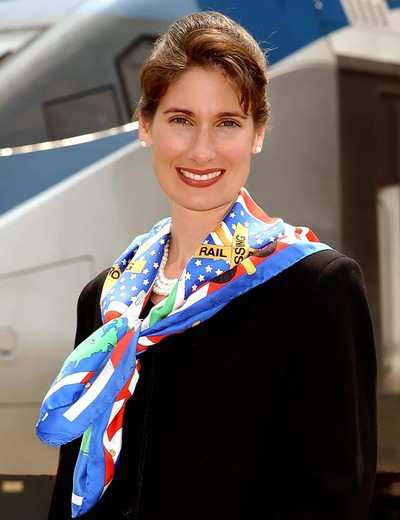
NTSB Chair Hersman
"A review of the FAA Near-Midair Collision (NMAC) database and
the National Aeronautics and Space Administration Aviation Safety
Reporting System (ASRS) database revealed 11 reports of NMACs
between aircraft in the area since 1990," she continued. "Only one
report was filed in the past 10 years. Although ASRS reporting is
voluntary, the number of reports received is very low relative to
the number of flight operations through the Hudson River class B
exclusion area."
Hersman reiterated NTSB's proposed changes to the class B
airspace in the Hudson River corridor. "On September 2, 2009, the
FAA announced plans to modify the airspace over the Hudson River,"
she said. "The NTSB will review the changes, once they are
completed and published, and determine if they meet the intent of
our recommendations."
More News
Light Gun A handheld directional light signaling device which emits a brilliant narrow beam of white, green, or red light as selected by the tower controller. The color and type of>[...]
“We have performed extensive ground testing by comparing warm up times, full power tethered pulls, and overall temperatures in 100 degree environments against other aircraft >[...]
While Taxiing To Parking The Right Landing Gear Leg Collapsed, Resulting In Substantial Damage Analysis: The pilot made a normal approach with full flaps and landed on the runway. >[...]
From 2014 (YouTube Edition): Exotic Rebuild Reveals Aerial Work Of Art During EAA AirVenture 2014, ANN's Michael Maya Charles took the time to get a history lesson about a great ai>[...]
Also: Project Talon, McFarlane Acquisition, Sky-Tec Service, JPL Earth Helo Tests Bombardier has earned a round of applause from the business aviation community, celebrating the fo>[...]



 ANN's Daily Aero-Term (12.13.25): Light Gun


 See All