Aircraft Under Development At Texas A&M University In Corpus Christi
An unmanned aircraft system (UAS) that its developers say could revolutionize the industry is under construction in the Unmanned Systems Laboratory at Texas A&M University-Corpus Christi. The craft, which is still in the development stages, can not only fly horizontally, it can fly vertically as well.
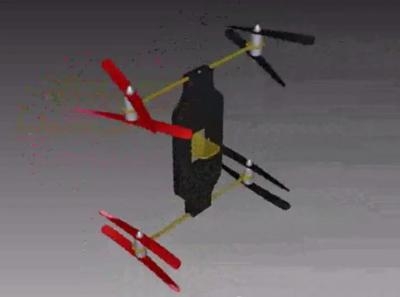
“This aircraft could be used for search and rescue in environments considered to be too complicated to access by means of conventional UAS,” said Dr. Luis Rodolfo Garcia Carrillo, Assistant Professor of Engineering and Director of the Unmanned Systems Laboratory.
Garcia Carrillo and a group of undergraduate researchers from the Mechanical Engineering program hope to have a prototype of the multi-rotorcraft with morphing capabilities by May 2015.
Unlike conventional small UAS rotorcrafts with four helicopter-like rotors, which fly in a horizontal mode, the proposed platform with eight rotors will be able to rotate its body into a vertical flying mode.
“The vertical flight mode is mainly intended for enabling navigation through narrow areas where conventional multi-copters are too big to access,” said Garcia Carrillo. “Also, the proposed prototype is able to operate with four engines, or even two engines, in case of rotor failure.”
What this means, for example, is you can send this aircraft, which will only weigh about four and a half pounds, in through a narrow window of a burning building looking for victims or hazards to firefighters. Furthermore, if the heat disables half of the engines, it can still fly. Garcia Carrillo says along with the extra rotors, the UAS will also have a camera, a wireless communication link and a proximity sensor. The onboard equipment could change depending on what the aircraft operator needed it to do.
Over the past few years the use of UAS technology has exploded around the globe, leading the FAA to designate Texas A&M University-Corpus Christi’s Lone Star Unmanned Aircraft Systems Center as one of six federal test sites for UAS. The goal for the center is to assist the FAA as it develops plans to safely integrate unmanned aircraft into the national airspace by 2015.
Areas of use for UAS are likely to include:
- Search-and rescue missions, surveying disaster areas or accident scenes;
- Mapping coastlines to observe changes over time; and
- Inventorying wildlife, habitats, agriculture and pipelines through remote areas.
- Studies show an anticipated economic impact, once airspace is opened to UAS, would be about $6.5 billion and 8,256 jobs in Texas alone from 2015 to 2025.
Garcia Carrillo, along with Christoph Hintz and Cody Torno, two undergraduate researchers, presented their design ideas in a paper titled, ‘Design and Dynamic Modeling of a Rotary Wing Aircraft with Morphing Capabilities,’ during the 2014 International Conference on Unmanned Aircraft Systems (ICUAS) in Florida earlier this year. Garcia Carrillo is on the ICUAS International Program Committee as a 2015 conference organizer. Next year’s International Conference on Unmanned Aircraft Systems will be held in Denver, Colo., and will focus on integrating UAS into the national airspace.
“This is just another example of how Texas A&M University-Corpus Christi students are learning both theoretical and practical aspects required for designing, building, improving, and repairing UAS platforms,” said Garcia Carrillo. “This expertise will make our students very appealing for industries interested in using UAS technology.”
(Image from Texas A&M YouTube video)



 ANN's Daily Aero-Term (12.13.25): Light Gun


 See All