
All-Electric Cri-Cri Takes First Flight In France | Aero-News Network
Aero-News Network
RSS icon RSS feed
podcast icon MP3 podcast
Subscribe Aero-News e-mail Newsletter Subscribe

Airborne Unlimited -- Most Recent Daily Episodes

Episode Date

Airborne-Monday

Airborne-Tuesday

Airborne-Wednesday Airborne-Thursday

Airborne-Friday

Airborne On YouTube

Airborne-Unlimited-12.01.25

AirborneNextGen-
12.02.25

Airborne-Unlimited-11.19.25

Airborne-AffordableFlyers-11.20.25

AirborneUnlimited-11.21.25

LIVE MOSAIC Town Hall (Archived): www.airborne-live.net

Fri, Sep 03, 2010

All-Electric Cri-Cri Takes First Flight In France

Four Electric Motors, Lithium Batteries Power Tiny Airplane

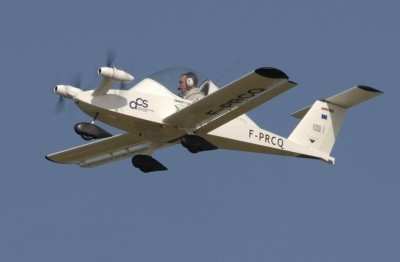
The all electric Cri-Cri, jointly developed by EADS Innovation Works, Aero Composites Saintonge and the Green Cri-Cri Association, made its official maiden flight at Le Bourget airport near Paris Thursday. This Cri-Cri is the first-ever four-engined all-electric aerobatic plane, which was first shown at the Green Aviation Show at Le Bourget in June.


Cri-Cri In Flight

The plane became airborne at 1112 CET. Test pilot Didier Esteyne said take-off and climb were smooth, no vibrations could be felt and maneuverability was excellent. All systems performed well and the plane returned safely after 7 minutes. “This aircraft flies very smoothly, much more quietly than a plane with conventional propulsion”, said Esteyne. “But we are still at the beginning and have a lot to learn. We are allowed to start aerobatic maneuvers only after five hours of flight and 15 landings.”

“The Cri-Cri is a low-cost test bed for system integration of electrical technologies in support of projects like our hybrid propulsion concept for helicopters,” stated Jean Botti, EADS’s Chief Technical Officer. “We hope to get a lot of useful information out of this project.” In the near future batteries will be available to propel larger aircraft.

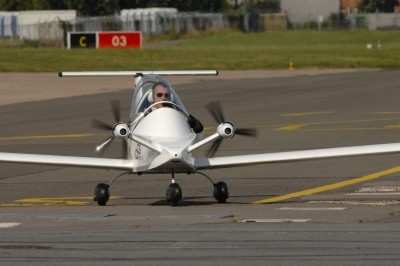
The aerobatic plane incorporates numerous innovative technologies such as lightweight composite structures that reduce the weight of the airframe and compensate for the additional weight of the batteries, four brushless electric motors with counter-rotating propellers which deliver propulsion without CO2 emissions and significantly lower noise compared to thermal propulsion, and high energy-density Lithium batteries. The combined utilization of these environment-friendly technical innovations enables the Cri-Cri to deliver  30 minutes of autonomous cruise flight at about 60 knots, or 15 minutes of autonomous aerobatics at speeds reaching up to 135 knots, and a climb rate of approximately 1,000 fpm.

FMI: www.eads.com

Advertisement

More News

NTSB Prelim: Cirrus Design Corp SR20

The Airplane Made An Uncommanded Right Yaw And Roll, And He Was Unable To Maintain Control Of The Airplane On November 11, 2025, about 1750 central standard time, a Cirrus SR20, N8>[...]

ANN's Daily Aero-Linx (11.30.25)

Aero Linx: Florida Antique Biplane Association "Biplanes.....outrageous fun since 1903." That quote really defines what the Florida Antique Biplane Association (FABA) is all about.>[...]

ANN's Daily Aero-Term (11.30.25): Wind Shear Escape

Wind Shear Escape An unplanned abortive maneuver initiated by the pilot in command (PIC) as a result of onboard cockpit systems. Wind shear escapes are characterized by maximum thr>[...]

Aero-News: Quote of the Day (11.30.25)

“Working closely with the Polish Armed Forces, we’re focused on disciplined execution to help enhance Poland’s defense capabilities and keep up with the strong de>[...]

Airborne 11.26.25: Bonanza-Baron Fini, Archer v LA NIMBYs, Gogo Loses$$$

Also: Bell 505 on SAF, NYPA Gets Flak For BizAv 'Abuse', FAA Venezuela Caution, Horizon Update Textron Aviation has confirmed it will be ending production of the Beechcraft Bonanza>[...]

blog comments powered by Disqus



Advertisement

Advertisement

Podcasts

Advertisement

© 2007 - 2025 Web Development & Design by Pauli Systems, LC

