
The ISS Is Falling! But NASA Isn't Concerned | Aero-News Network
Aero-News Network
RSS icon RSS feed
podcast icon MP3 podcast
Subscribe Aero-News e-mail Newsletter Subscribe

Airborne Unlimited -- Most Recent Daily Episodes

Episode Date

Airborne-Monday

Airborne-Tuesday

Airborne-Wednesday Airborne-Thursday

Airborne-Friday

Airborne On YouTube

Airborne-SpecialEpisode-12.15.25

AirborneNextGen-
12.16.25

Airborne-Unlimited-12.10.25

Airborne-AffordableFlyers-12.11.25

AirborneUnlimited-12.12.25

AFE 2025 LIVE MOSAIC Town Hall (Archived): www.airborne-live.net

Sat, Mar 17, 2007

The ISS Is Falling! But NASA Isn't Concerned

Station Hits Lowest Average Altitude In History Of Project

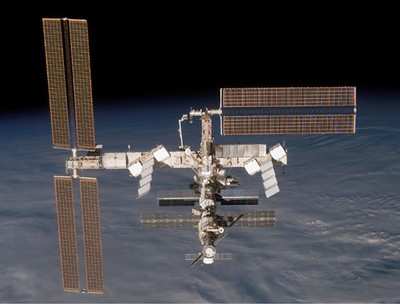
Say... is that bright light in the sky getting closer? If you're looking at the International Space Station... why yes, it is. But NASA says there's no reason panic.

MSNBC reports NASA's tracking data shows the nine-year-old station's orbital path has slipped to just 207 miles above the Earth, its lowest average altitude ever. Rocket burns meant to send the station into a higher orbit -- such as the series carried out this week, using the engine of a docked Russian Progress module -- have resulted in only slight improvements.

The station has been falling since its first components were placed in low-earth-orbit back in 1998, due to constant atmospheric drag. But the decline took a noticeable dip in 2003, when NASA grounded its space shuttle fleet following the loss of Columbia. Visiting shuttles had been able to give sizable reboosts to the station; since 2003, however, such firings have been done by the much smaller Russian capsules.

NASA maintains the station's orbit is stable, and the Russian firings are enough to keep the station from slipping ever closer to Earth. Once larger components of the station are delivered and installed by the space shuttle next year, the orbiters will resume the primary responsibility for correcting the station's orbit.

"Our altitude is driven by shuttle rendezvous altitude limits," said Mission Control expert Ainsley Collins, who along with her Russian counterpart helps coordinate reboost firings, and other maneuvers.

"The lowest the station orbit has ever been was on May 23, 2000," Collins recalled, when the station reached its lowest point after dropping 43 miles from a high orbit of 250 miles. A shuttle then pushed the station higher... and over the next two years, the station remained relatively stable at around 246 miles. Then the slide began.

Collins added the boosts are barely noticeable to the station's crew. The force produced by Thursday's 12.5-minute firing of the Progress module's manuevering rockets only resulted in about .5 g's of pull.

FMI: www.nasa.gov

Advertisement

More News

ANN's Daily Aero-Term (12.13.25): Light Gun

Light Gun A handheld directional light signaling device which emits a brilliant narrow beam of white, green, or red light as selected by the tower controller. The color and type of>[...]

Aero-News: Quote of the Day (12.13.25)

“We have performed extensive ground testing by comparing warm up times, full power tethered pulls, and overall temperatures in 100 degree environments against other aircraft >[...]

NTSB Final Report: Gippsland GA-8

While Taxiing To Parking The Right Landing Gear Leg Collapsed, Resulting In Substantial Damage Analysis: The pilot made a normal approach with full flaps and landed on the runway. >[...]

Classic Aero-TV: Historically Unique -- Marlin Horst's Exquisite Fairchild 71

From 2014 (YouTube Edition): Exotic Rebuild Reveals Aerial Work Of Art During EAA AirVenture 2014, ANN's Michael Maya Charles took the time to get a history lesson about a great ai>[...]

Airborne 12.12.25: Global 8000, Korea Pilot Honors, AV-30 Update

Also: Project Talon, McFarlane Acquisition, Sky-Tec Service, JPL Earth Helo Tests Bombardier has earned a round of applause from the business aviation community, celebrating the fo>[...]

blog comments powered by Disqus



Advertisement

Advertisement

Podcasts

Advertisement

© 2007 - 2025 Web Development & Design by Pauli Systems, LC

