Wed, Oct 03, 2018
Up To Three Additional Center Tanks (ACTs) Are Now Certified On The Aircraft, Including For ETOPS Operation
Readiness to start “Long Range” (LR) operations with launch customers of the most capable and flexible A321neo version to date – the A321LR – has moved a significant step closer with recent joint EASA and FAA approval of the aircraft to operate with up to three underfloor Additional Center Tanks (ACTs), including for ETOPS operation.
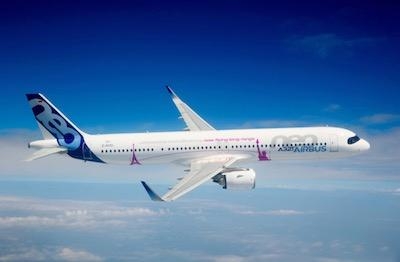
This latest milestone is one of various A321neo capability options which when combined, allow the A321LR version to fly up to 4,000 nm with 206 passengers with extra fuel stored in three ACTs, including on ETOPS routes. Moreover, the ETOPS authorisation enables up to 180 minutes single-engine diversion time, which is sufficient for performing any transatlantic route.
The A321LR’s certification includes: (a) approval of the “major change” to install up to three optional ACTs in the A321neo – with their associated new fuel management systems and lower-fuselage structural reinforcements; and (b) the approval of the A321neo’s “Airbus Cabin Flex” (ACF) option which incorporates a modified fuselage structure with new door arrangements together with a higher Maximum Take-Off Weight (MTOW) capability of up to 97 metric tons. It should be noted that only A321neos which have the new ACF structure can offer the 97 metric ton MTOW and the ability to install three ACTs. Previously, the A321 Family could accommodate up to two ACTs.
While the ACF configuration will become standard for all new delivered A321neos from around 2020, the 97 metric ton MTOW capability and the ability to carry up to three ACTs will be options. For the ACTs, customers would specify prior to aircraft manufacture whether the aircraft is to be equipped with an expanded fuel management system as well as the necessary structural reinforcements to secure the underfloor ACTs.
The ability to add or remove ACTs, combined with the Airbus Cabin Flex, the 97 metric ton MTOW capability and the EASA/FAA approval to use the ACTs with ETOPS, together confer unprecedented airline flexibility for cabin layouts, seating density, cargo payload, fuel-capacity and mission routing.
(Source: Airbus news release)
More News
The Airplane Made An Uncommanded Right Yaw And Roll, And He Was Unable To Maintain Control Of The Airplane On November 11, 2025, about 1750 central standard time, a Cirrus SR20, N8>[...]
Aero Linx: Florida Antique Biplane Association "Biplanes.....outrageous fun since 1903." That quote really defines what the Florida Antique Biplane Association (FABA) is all about.>[...]
Wind Shear Escape An unplanned abortive maneuver initiated by the pilot in command (PIC) as a result of onboard cockpit systems. Wind shear escapes are characterized by maximum thr>[...]
“Working closely with the Polish Armed Forces, we’re focused on disciplined execution to help enhance Poland’s defense capabilities and keep up with the strong de>[...]
Also: Bell 505 on SAF, NYPA Gets Flak For BizAv 'Abuse', FAA Venezuela Caution, Horizon Update Textron Aviation has confirmed it will be ending production of the Beechcraft Bonanza>[...]



 NTSB Prelim: Cirrus Design Corp SR20


 See All