Thu, Jun 24, 2010
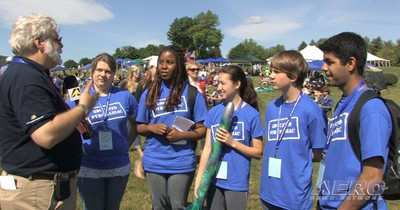
One of our favorite stories at TARC 2010 unfolded before our
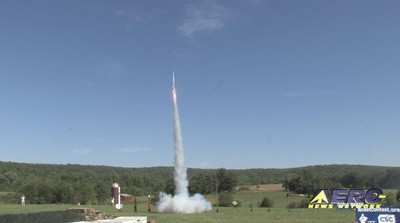
cameras as we watched a high school team hit a bad run of luck...
one misfire... then another... followed by a last minute
(literally) launch that occurred right before the deadline that
would have disqualified them from the competition. We were thrilled
with their perseverance, their grace under pressure and the fact
that even when the pressure was on, they were having fun. The
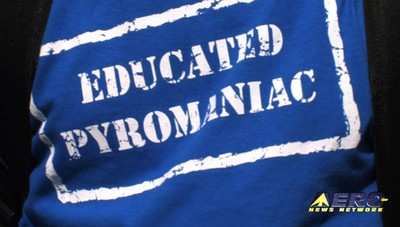
members of the Ingraham High School's 'Educated Pyros' impressed
the heck out of us.

The Team America Rocketry Challenge (TARC) is an aerospace
design and engineering event for teams of US secondary school
students (7th through 12th grades) run by the NAR and the Aerospace
Industries Association (AIA). Teams can be sponsored by schools or
by non-profit youth organizations such as Scouts, 4-H, or Civil Air
Patrol (but not the NAR or other rocketry organizations).
The goal of TARC is to motivate students to pursue aerospace as
an exciting career field, and it is co-sponsored by the American
Association of Physics Teachers, 4-H, the Department of Defense,
and NASA. The event involves designing and building a model rocket
(2.2 pounds or less, using NAR-certified model rocket motors
totaling no more than 80.0 Newton-seconds of total impulse) that
carries a payload of 1 Grade A Large egg for a flight duration of
40 - 45 seconds, and to an altitude of exactly 825 feet (measured
by an onboard altimeter), and that then returns the egg to earth
uncracked using only a streamer as a recovery device. Onboard
timers are allowed; radio-control and pyrotechnic charges are
not.
The first seven Team America Rocketry Challenges, held in 2003
through 2009, were the largest model rocket contests ever held.
Co-sponsored by the NAR and the Aerospace Industries Association
(AIA), the five events together attracted about 5,100 high-school
teams made up of a total of over 50,000 students from all 50
states. These students had a serious interest in learning about
aerospace design and engineering through model rocketry.
The top 100 teams each year came to a final fly-off competition
in late May near Washington, DC, to compete for $60,000 in prizes.
These teams were selected based on the scores reported from
qualification flights that they conducted locally throughout the
US.
More News
From 2023 (YouTube Edition): "Ain’t Your Daddy’s Super Cub”—Don Wade Co-owned by Don and Ron Wade—the former of Don’s Dream Machines, a storied >[...]
Pilot-Rated Passenger Reported That The Pilot Did Not Adequately “Round Out” The Landing Flare And The Airplane Bounced And Yawed To The Right Analysis: The pilot state>[...]
Dead Reckoning Dead reckoning, as applied to flying, is the navigation of an airplane solely by means of computations based on airspeed, course, heading, wind direction, and speed,>[...]
Aero Linx: Lake Amphibian Club This website is created and sponsored by the Lake Amphibian Club, to help spread the word about these wonderful, versatile amphibians that can land j>[...]
“I am deeply honored to be sworn in as NASA administrator. NASA’s mission is as imperative and urgent as ever — to push the boundaries of human exploration, ignit>[...]



 Classic Aero-TV: In Praise of Alabamas Patriot Aircraft USA


 See All