Aero-Tips!
A good pilot is always learning -- how many times have you heard
this old standard throughout your flying career? There is no truer
statement in all of flying (well, with the possible exception of
"there are no old, bold pilots.")

Aero-News has called upon the expertise of Thomas P. Turner,
master CFI and all-around-good-guy, to bring our readers -- and us
-- daily tips to improve our skills as aviators. Some of them, you
may have heard before... but for each of us, there will also be
something we might never have considered before, or something that
didn't "stick" the way it should have the first time we memorized
it for the practical test.
Look for our daily Aero-Tips segments, coming each day to you
through the Aero-News Network.
Aero-Tips 12.17.06
A recent Aero-News Network story facetiously warned pilots to "beware the wrath of
Dreamlifter". In one of the superfreighter's
recent headline-making events, a Cessna 172 encountered the
Boeing's wake turbulence, "rolled almost instantly to a 90 degree
right bank, and descended in a nearly straight nose down attitude.
The flight instructor took control of the aircraft, and was able to
complete a recovery approximately 150 feet above the...
water..."
Wake-induced roll
The usual hazard of encountering wake turbulence is induced
rolling moments exceeding the roll-control authority of the
aircraft. According to the FAA, the capability of an aircraft to
counteract wake-induced roll "primarily depends on the wingspan and
counter-control responsiveness of the encountering aircraft."
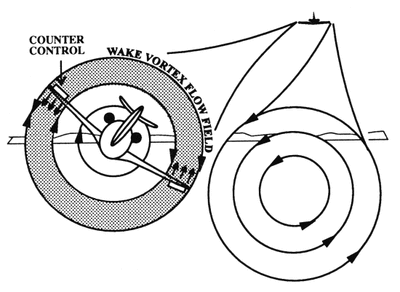
If the airplane caught up in another's wake has a wingspan
greater than the diameter of the wake rotation, then the
encountering airplane will usually be able to ride out the wake
without loss of control. This is primarily why an MD-80 crew, for
instance, doesn't worry too much about wake turbulence from a
Cessna Citation, while the pilot of a Piper Archer behind that
Cessna needs to work to avoid what for him/her may be an
unrecoverable wake-induced roll. Sayeth the FAA: "It is more
difficult for aircraft with short wingspan (relative to the
generating aircraft) to counter the imposed roll induced by vortex
flow. Pilots of short span aircraft, even of the high performance
type, must be especially alert to vortex encounters."
Really unusual attitudes
Attempting to recover from wake-induced roll with opposite bank
input (the natural impulse) may overstress the airplane and lead to
disaster. Beyond 70 degrees of bank or so, or with a very fast rate
of roll, it may be safer to recover by deflecting controls in the
direction of the roll, and rolling all the way around to an upright
position. This is where training really pays off. I took an unusual
attitudes and emergencies course several years ago at Delta
Aviation in Stillwater, OK. After an introduction to maneuvers
including rolls (in an aerobatic-certified Decathalon, and wearing
parachutes as required by regulation), instructor Fred de Lacerta
presented in-flight simulations of wake-induced roll and showed how
a simple aileron roll, going with the flow, allowed a pullout with
very little g-loading.
It's becoming quite common for corporate flight departments and
ab initio commercial pilot training programs to include "emergency
aerobatics" courses in their syllabi.
Aero-tip of the day: Consider investing in
emergency aerobatics course to add tricks like wake-turbulence
escape to repertoire.



 ANN's Daily Aero-Term (12.13.25): Light Gun


 See All