Tue, Nov 22, 2016
Request For Information Seeks Input From The Public On Cost Reductions
NASA has posted a Request for Information (RFI) calling for input from the public on how the agency might trim the cost of developing its Space Launch System and Orion capsule.
According to the description page posted to the GSA website: "NASA" invites industry and academia to submit responses to this Request for Information (RFI) to assist NASA in maximizing the long term efficiency and sustainability of the Exploration Systems Development (ESD) programs, including the Space Launch System (SLS), Orion, and Exploration Ground Systems (EGS) by minimizing production, operations, and maintenance (POM) costs. NASA will use information obtained as a result of this RFI on a non-attribution basis as part of future planning. The information submitted in response to this RFI will inform future acquisition approaches and concepts."
The Agency says in the document that with the ESD programs now past their respective critical design reviews (CDRs) and the Exploration Mission 1 (EM-1) flight articles in production, "NASA is transitioning from design and development to long-term affordability and sustainability within a broader exploration framework. In this evolving environment, NASA is looking to transform traditional acquisition approaches and acquire services with low overhead and additional direct accountability to providers for those acquired services. For NASA to change acquisition methods, considerations of proprietary design and intellectual property should be discussed. Further considerations that allow an effective corporate business plan should be discussed. The approach should discuss the sustainability of a new acquisition process from a corporate revenue position."
There is some sense of urgency to the RFI, as the federal government will be under new management in January. While President-elect Trump has said that he wants NASA to concentrate on the exploration of Mars ... the prime mission for the SLS and Orion ... budget cuts to NASA could make that far more challenging.
Engadget reports that Bill Hill, NASA's Deputy Associate Administrator for Exploration Systems Development, told Ars Technica earlier this year that the program is "just way too expensive today. It's going to take some different thinking and maybe a little bit more risk taking than what we're wanting to do today."
While private space companies such as SpaceX, ULA and Blue Origin have heavy-lift rockets under development. What remains a wildcard is whether NASA will be able to build and maintain a heavy-lift system that will be competitive with those built by private industry. The agency hopes President Trump will continue to invest in the SLS and Orion projects, and that it will be flying by 2023.
The deadline for making input into how the programs might save some money is December 23.
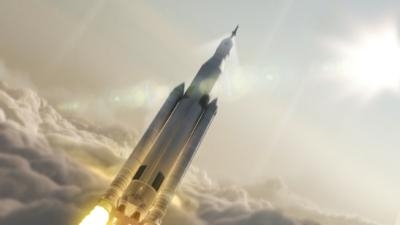
(Artist's rendering of SLS pictured in file photo)
More News
Light Gun A handheld directional light signaling device which emits a brilliant narrow beam of white, green, or red light as selected by the tower controller. The color and type of>[...]
“We have performed extensive ground testing by comparing warm up times, full power tethered pulls, and overall temperatures in 100 degree environments against other aircraft >[...]
While Taxiing To Parking The Right Landing Gear Leg Collapsed, Resulting In Substantial Damage Analysis: The pilot made a normal approach with full flaps and landed on the runway. >[...]
From 2014 (YouTube Edition): Exotic Rebuild Reveals Aerial Work Of Art During EAA AirVenture 2014, ANN's Michael Maya Charles took the time to get a history lesson about a great ai>[...]
Also: Project Talon, McFarlane Acquisition, Sky-Tec Service, JPL Earth Helo Tests Bombardier has earned a round of applause from the business aviation community, celebrating the fo>[...]



 ANN's Daily Aero-Term (12.13.25): Light Gun


 See All