
NASA Hubble Finds New Neptune Moon | Aero-News Network
Aero-News Network
RSS icon RSS feed
podcast icon MP3 podcast
Subscribe Aero-News e-mail Newsletter Subscribe

Airborne Unlimited -- Most Recent Daily Episodes

Episode Date

Airborne-Monday

Airborne-Tuesday

Airborne-Wednesday Airborne-Thursday

Airborne-Friday

Airborne On YouTube

Airborne-SpecialEpisode-12.15.25

AirborneNextGen-
12.16.25

Airborne-Unlimited-12.10.25

Airborne-AffordableFlyers-12.11.25

AirborneUnlimited-12.12.25

AFE 2025 LIVE MOSAIC Town Hall (Archived): www.airborne-live.net

Wed, Jul 17, 2013

NASA Hubble Finds New Neptune Moon

Smallest Of The Satellites Is Not More Than 12 Miles Across

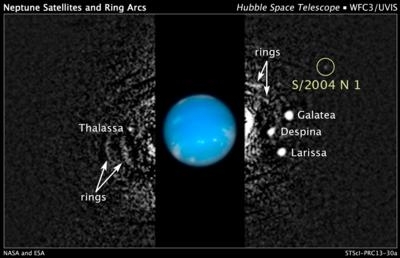
NASA's Hubble Space Telescope has discovered a new moon orbiting the distant blue-green planet Neptune, the 14th known to be circling the giant planet.

The moon, designated S/2004 N 1, is estimated to be no more than 12 miles across, making it the smallest known moon in the Neptunian system. It is so small and dim that it is roughly 100 million times fainter than the faintest star that can be seen with the naked eye. It even escaped detection by NASA's Voyager 2 spacecraft, which flew past Neptune in 1989 and surveyed the planet's system of moons and rings.

Mark Showalter of the SETI Institute in Mountain View, CA, found the moon July 1, while studying the faint arcs, or segments of rings, around Neptune. "The moons and arcs orbit very quickly, so we had to devise a way to follow their motion in order to bring out the details of the system," he said. "It's the same reason a sports photographer tracks a running athlete -- the athlete stays in focus, but the background blurs."

The method involved tracking the movement of a white dot that appears over and over again in more than 150 archival Neptune photographs taken by Hubble from 2004 to 2009.

On a whim, Showalter looked far beyond the ring segments and noticed the white dot about 65,400 miles from Neptune, located between the orbits of the Neptunian moons Larissa and Proteus. The dot is S/2004 N 1. Showalter plotted a circular orbit for the moon, which completes one revolution around Neptune every 23 hours.

(Graphic provided by NASA.)

FMI: www.nasa.gov/hubble

Advertisement

More News

ANN's Daily Aero-Term (12.13.25): Light Gun

Light Gun A handheld directional light signaling device which emits a brilliant narrow beam of white, green, or red light as selected by the tower controller. The color and type of>[...]

Aero-News: Quote of the Day (12.13.25)

“We have performed extensive ground testing by comparing warm up times, full power tethered pulls, and overall temperatures in 100 degree environments against other aircraft >[...]

NTSB Final Report: Gippsland GA-8

While Taxiing To Parking The Right Landing Gear Leg Collapsed, Resulting In Substantial Damage Analysis: The pilot made a normal approach with full flaps and landed on the runway. >[...]

Classic Aero-TV: Historically Unique -- Marlin Horst's Exquisite Fairchild 71

From 2014 (YouTube Edition): Exotic Rebuild Reveals Aerial Work Of Art During EAA AirVenture 2014, ANN's Michael Maya Charles took the time to get a history lesson about a great ai>[...]

Airborne 12.12.25: Global 8000, Korea Pilot Honors, AV-30 Update

Also: Project Talon, McFarlane Acquisition, Sky-Tec Service, JPL Earth Helo Tests Bombardier has earned a round of applause from the business aviation community, celebrating the fo>[...]

blog comments powered by Disqus



Advertisement

Advertisement

Podcasts

Advertisement

© 2007 - 2025 Web Development & Design by Pauli Systems, LC

