
Russian Yak-42 Accident Caused By Pilot Error | Aero-News Network
Aero-News Network
RSS icon RSS feed
podcast icon MP3 podcast
Subscribe Aero-News e-mail Newsletter Subscribe

Airborne Unlimited -- Most Recent Daily Episodes

Episode Date

Airborne-Monday

Airborne-Tuesday

Airborne-Wednesday Airborne-Thursday

Airborne-Friday

Airborne On YouTube

Airborne-Unlimited-12.01.25

AirborneNextGen-
12.02.25

Airborne-Unlimited-11.19.25

Airborne-AffordableFlyers-11.20.25

AirborneUnlimited-11.21.25

LIVE MOSAIC Town Hall (Archived): www.airborne-live.net

Thu, Nov 03, 2011

Russian Yak-42 Accident Caused By Pilot Error

Interstate Aviation Committee Report Says Brakes Applied During Takeoff, Co-Pilot Tested Positive For Drugs

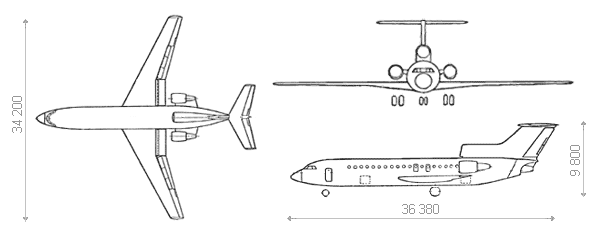
The September crash of a Yak-42 which resulted in the fatal injury of the entire Russian hockey team Lokomotiv was caused by multiple pilot errors, according to the official report from the Interstate Aviation Committee.

The report, published Wednesday in Russia, says that the primary cause of the accident was "incorrect braking," which caused problems during takeoff. In the report, the chair of the investigations technical commission Aleksey Morozov wrote that both pilots had previously flown Yak-40s, which have a different brake pedal configuration than the Yak-42. “Erroneous pressing of the braking pedals by the crew during take-off is only possible if a pilot’s feet are placed wrongly. An action, which is small in terms of force applied and movement of the pedal, may not be noticed by the pilot,” he said, adding that had the crew aborted the takeoff, the accident would have been avoided.

The report also says that neither pilot was adequately trained in the Yak-42, and places the blame for the lack of training on Yak-Service, the airline which owned the aircraft. “The captain of the vehicle didn’t receive the full piloting course for a Yak-42, just the theoretical part. The simulator training was treated as a pure formality and done irregularly, so proper piloting skills couldn’t build up,” the commission chair said.

The Russian News Service RT Novosti reports that another contributing factor, according to the document, was the presence of Phenobarbital in the co-pilot's blood. He reportedly had a history of medical problems.

The report says that the plane was airworthy, and there was no mechanical failure leading to the crash. The IAC also dismissed the suggestion that the crew was under pressure from Air Traffic Control to depart quickly due to a high number of flights the day of the accident.

FMI: www.mak.ru/english/english.html

Advertisement

More News

NTSB Prelim: Cirrus Design Corp SR20

The Airplane Made An Uncommanded Right Yaw And Roll, And He Was Unable To Maintain Control Of The Airplane On November 11, 2025, about 1750 central standard time, a Cirrus SR20, N8>[...]

ANN's Daily Aero-Linx (11.30.25)

Aero Linx: Florida Antique Biplane Association "Biplanes.....outrageous fun since 1903." That quote really defines what the Florida Antique Biplane Association (FABA) is all about.>[...]

ANN's Daily Aero-Term (11.30.25): Wind Shear Escape

Wind Shear Escape An unplanned abortive maneuver initiated by the pilot in command (PIC) as a result of onboard cockpit systems. Wind shear escapes are characterized by maximum thr>[...]

Aero-News: Quote of the Day (11.30.25)

“Working closely with the Polish Armed Forces, we’re focused on disciplined execution to help enhance Poland’s defense capabilities and keep up with the strong de>[...]

Airborne 11.26.25: Bonanza-Baron Fini, Archer v LA NIMBYs, Gogo Loses$$$

Also: Bell 505 on SAF, NYPA Gets Flak For BizAv 'Abuse', FAA Venezuela Caution, Horizon Update Textron Aviation has confirmed it will be ending production of the Beechcraft Bonanza>[...]

blog comments powered by Disqus



Advertisement

Advertisement

Podcasts

Advertisement

© 2007 - 2025 Web Development & Design by Pauli Systems, LC

