
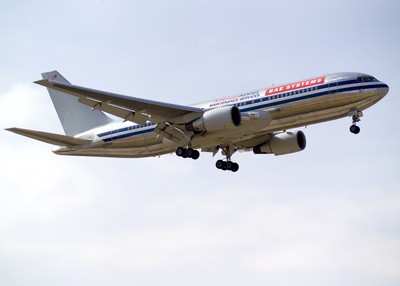
AD: Boeing | Aero-News Network
Aero-News Network
RSS icon RSS feed
podcast icon MP3 podcast
Subscribe Aero-News e-mail Newsletter Subscribe

Airborne Unlimited -- Most Recent Daily Episodes

Episode Date

Airborne-Monday

Airborne-Tuesday

Airborne-Wednesday Airborne-Thursday

Airborne-Friday

Airborne On YouTube

Airborne-SpecialEpisode-12.15.25

AirborneNextGen-
12.16.25

Airborne-Unlimited-12.10.25

Airborne-AffordableFlyers-12.11.25

AirborneUnlimited-12.12.25

AFE 2025 LIVE MOSAIC Town Hall (Archived): www.airborne-live.net

Wed, Jun 22, 2011

AD: Boeing

AD NUMBER: 2011-12-11

MANUFACTURER: The Boeing Company Model 767 Airplanes
SUBJECT: Airworthiness Directive 2011-12-11

SUMMARY: The FAA is superseding an existing airworthiness directive (AD) for the products listed above.

That AD currently requires, for certain airplanes, reworking the bonding jumper assemblies on the drain tube assemblies of the slat track housing of the wings. For certain other airplanes, the existing AD requires repetitive inspections of the drain tube assemblies of the slat track housing of the wings to find discrepancies, corrective actions if necessary, and terminating action for the repetitive inspections.

This new AD also requires replacing the drain tube assemblies. For certain airplanes, this new AD also requires installing an additional electrostatic bond path for the number 5 and 8 inboard slat track drain tube assemblies. For certain other airplanes, this new AD also requires reworking the bonding jumper assembly. This new AD also revises the applicability to include additional airplanes.

This AD was prompted by (1) reports of fuel leaks from certain drain locations of the slat track housing near the engine exhaust nozzle, which could result in a fire when the airplane is stationary, or taxiing at low speed; (2) reports of a bonding jumper assembly of certain drain tubes that did not meet bonding specifications and could result in electrostatic discharge and an in-tank ignition source; and (3) reports of fuel leaks onto the main landing gear (MLG) as a result of a cracked drain tube at the number 5 or 8 slat track housing, which could let fuel drain from the main fuel tanks into the dry bay area of the wings and onto hot MLG brakes and result in a fire.

FMI: http://rgl.faa.gov/Regulatory_and_Guidance_Library/rgAD.nsf/0/56771F843B0C0C06862578B2004D6A44?OpenDocument

Advertisement

More News

ANN's Daily Aero-Term (12.19.25): Ultrahigh Frequency (UHF)

Ultrahigh Frequency (UHF) The frequency band between 300 and 3,000 MHz. The bank of radio frequencies used for military air/ground voice communications. In some instances this may >[...]

NTSB Prelim: Cirrus Design Corp SR22T

During The 7 Second Descent, There Was Another TAWS Alert At Which Time The Engine Remained At Full Power On October 24, 2025 at 2115 mountain daylight time, a Cirrus SR22T, N740TS>[...]

Classic Aero-TV: The Red Tail Project--Carrying the Torch of the Tuskegee Airmen

From 2009 (YouTube Edition): Educational Organization Aims to Inspire by Sharing Tuskegee Story Founding leader Don Hinz summarized the Red Tail Project’s mission in simple, >[...]

Aero-News: Quote of the Day (12.19.25)

“This feels like an important step since space travel for people with disabilities is still in its very early days... I’m so thankful and hope it inspires a change in m>[...]

Airborne 12.17.25: Skydiver Hooks Tail, Cooper Rotax Mount, NTSB v NDAA

Also: New Katanas, Kern County FD Training, IndiGo’s Botched Roster, MGen. Leavitt Named ERAU Dean The Australian Transportation Safety Bureau (ATSB) has wrapped up its inves>[...]

blog comments powered by Disqus



Advertisement

Advertisement

Podcasts

Advertisement

© 2007 - 2025 Web Development & Design by Pauli Systems, LC

