
Navy Says Signal Interference With Qantas Flight 'Highly Unlikely' | Aero-News Network
Aero-News Network
RSS icon RSS feed
podcast icon MP3 podcast
Subscribe Aero-News e-mail Newsletter Subscribe

Airborne Unlimited -- Most Recent Daily Episodes

Episode Date

Airborne-Monday

Airborne-Tuesday

Airborne-Wednesday Airborne-Thursday

Airborne-Friday

Airborne On YouTube

Airborne-SpecialEpisode-12.15.25

AirborneNextGen-
12.16.25

Airborne-Unlimited-12.10.25

Airborne-AffordableFlyers-12.11.25

AirborneUnlimited-12.12.25

AFE 2025 LIVE MOSAIC Town Hall (Archived): www.airborne-live.net

Mon, Nov 17, 2008

Navy Says Signal Interference With Qantas Flight 'Highly Unlikely'

Authorities To Investigate Transmissions From Sub Base

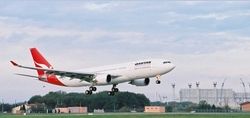
The Australian Transport Safety Bureau said on Friday that it intends to investigate the possibility that communications signals, originating from Harold E. Holt Naval Communications Base in Western Australia, may have caused interference with flight control systems aboard a Qantas airliner last month.

Calling the idea "highly unlikely," Base Manager Russell Levien said that if signals from the Base were to blame, planes would regularly be affected by them. "We'd have planes down all around us if it was us (who caused the problem)," he said.

The incident occurred about 100 miles from Holt Naval Base, which uses very low frequency signals to communicate with US and Australian submarines in the area, The Weekend Australian said.

After reviewing transmissions on the day of the incident, Levien said he did not find anything unusual. He also checked with similar naval communication bases around the world -- including a US Naval Station at Cutler, ME -- none of which had received any reports of their transmissions interfering with aircraft.

As ANN reported, the Qantas flight was enroute from Singapore to Perth on October 7 when pilots received alarms about "some irregularity with the aircraft's elevator control system", before a 300-foot uncommanded ascent followed by an abrupt 350-foot nosedive occurred, injuring numerous passengers and crew.

Latest reports list 70 people were injured in the incident, 14 of them seriously. Initially blamed on clear air turbulence, a later theory speculated in-flight use of a lap-top computer may have interfered with the plane's flight control systems.

Further research into the cause of the incident is expected to be conducted this week at Northrop Grumman's US facilities, as experts test a component possibly at fault for sending errant signals to the plane's flight control computers.

FMI: www.qantas.com, www.atsb.gov.au

Advertisement

More News

ANN's Daily Aero-Term (12.13.25): Light Gun

Light Gun A handheld directional light signaling device which emits a brilliant narrow beam of white, green, or red light as selected by the tower controller. The color and type of>[...]

Aero-News: Quote of the Day (12.13.25)

“We have performed extensive ground testing by comparing warm up times, full power tethered pulls, and overall temperatures in 100 degree environments against other aircraft >[...]

NTSB Final Report: Gippsland GA-8

While Taxiing To Parking The Right Landing Gear Leg Collapsed, Resulting In Substantial Damage Analysis: The pilot made a normal approach with full flaps and landed on the runway. >[...]

Classic Aero-TV: Historically Unique -- Marlin Horst's Exquisite Fairchild 71

From 2014 (YouTube Edition): Exotic Rebuild Reveals Aerial Work Of Art During EAA AirVenture 2014, ANN's Michael Maya Charles took the time to get a history lesson about a great ai>[...]

Airborne 12.12.25: Global 8000, Korea Pilot Honors, AV-30 Update

Also: Project Talon, McFarlane Acquisition, Sky-Tec Service, JPL Earth Helo Tests Bombardier has earned a round of applause from the business aviation community, celebrating the fo>[...]

blog comments powered by Disqus



Advertisement

Advertisement

Podcasts

Advertisement

© 2007 - 2025 Web Development & Design by Pauli Systems, LC

