Wed, Sep 14, 2005
Safety Bureau Chief Tells FAA: Go Back To The Drawing
Board
 National Transportation Safety Board
Acting Chairman Mark Rosenker today said that the Federal Aviation
Administration's Airport Movement Area Safety System is not
adequate to prevent serious runway collisions.
National Transportation Safety Board
Acting Chairman Mark Rosenker today said that the Federal Aviation
Administration's Airport Movement Area Safety System is not
adequate to prevent serious runway collisions.
Citing several recent near-collisions where AMASS did not
perform, Rosenker noted that the situations were instead resolved
by flight crew actions sometimes bordering on the heroic, and luck.
"That is not good enough," he said in a speech Tuesday morning at
the American Association of Airport Executives' Runway and Airport
Safety Summit.
AMASS is designed to prevent runway incursions by warning air
traffic controllers of potential surface collisions. However there
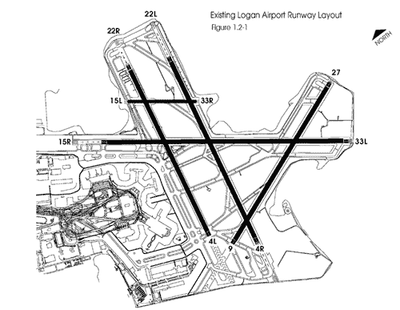
have been several recent serious incursions, including a June 9
incident at Boston's Logan Airport and a July 6 incident at New
York's John F. Kennedy Airport, where the installed AMASS did not
provide an effective alert because the system was disabled to
prevent nuisance alerts or it provided the alert too late for
controllers to issue instructions to the affected crews.
Preventing runway incursions has been on the Board's list of
Most Wanted safety improvements since its inception. The Most
Wanted recommendation asks the FAA to develop a system to provide
immediate warnings of probable collisions directly to flight crews
in the cockpit. As designed, AMASS provides warnings only to air
traffic controllers, requiring the controller to determine the
nature of the problem, identify the aircraft involved, determine
what action to take, and issue appropriate instructions to the
flight crews often in a matter of seconds. In the case of the
August 19, 2004 incident at Los Angeles involving an Asiana
Airlines Boeing 747 and a Southwest Airlines 737, the AMASS warning
activated only about 10 seconds before the two aircraft would have
potentially collided. The pilot of the Asiana 747 took evasive
action shortly before the AMASS warning activated.
Rosenker also discussed recent incursions in Boston and New York
where AMASS failed to alert controllers to dangerous circumstances
because of software design and radar system performance
limitations. AMASS does not detect conflicts between aircraft on
converging runways and is ineffective during heavy rain.
Rosenker applauded the FAA's work on new systems to prevent
runway incursions and encouraged them to develop and implement the
solutions as quickly as possible. He highlighted several Safety
Board recommendations that could be implemented quickly including
rigorous standards for marking closed runways, improved
communication techniques for controllers, and discontinuing the
practice of allowing departing aircraft to hold on active runways
at nighttime or at any time when ceiling/visibility preclude
arriving aircraft from seeing traffic on the runway in time to
initiate a go-around. Rosenker acknowledged that some changes may
affect airport capacity but stated, "While capacity is important,
safety is more important."
More News
Light Gun A handheld directional light signaling device which emits a brilliant narrow beam of white, green, or red light as selected by the tower controller. The color and type of>[...]
“We have performed extensive ground testing by comparing warm up times, full power tethered pulls, and overall temperatures in 100 degree environments against other aircraft >[...]
While Taxiing To Parking The Right Landing Gear Leg Collapsed, Resulting In Substantial Damage Analysis: The pilot made a normal approach with full flaps and landed on the runway. >[...]
From 2014 (YouTube Edition): Exotic Rebuild Reveals Aerial Work Of Art During EAA AirVenture 2014, ANN's Michael Maya Charles took the time to get a history lesson about a great ai>[...]
Also: Project Talon, McFarlane Acquisition, Sky-Tec Service, JPL Earth Helo Tests Bombardier has earned a round of applause from the business aviation community, celebrating the fo>[...]



 ANN's Daily Aero-Term (12.13.25): Light Gun


 See All