
NASA Puts Orion Backup Parachutes To The Test | Aero-News Network
Aero-News Network
RSS icon RSS feed
podcast icon MP3 podcast
Subscribe Aero-News e-mail Newsletter Subscribe

Airborne Unlimited -- Most Recent Daily Episodes

Episode Date

Airborne-Monday

Airborne-Tuesday

Airborne-Wednesday Airborne-Thursday

Airborne-Friday

Airborne On YouTube

Airborne-SpecialEpisode-12.15.25

AirborneNextGen-
12.16.25

Airborne-Unlimited-12.10.25

Airborne-AffordableFlyers-12.11.25

AirborneUnlimited-12.12.25

AFE 2025 LIVE MOSAIC Town Hall (Archived): www.airborne-live.net

Sat, Dec 22, 2012

NASA Puts Orion Backup Parachutes To The Test

'Everything Went As Planned' As Mockup Vehicle Landed Safely In The Desert

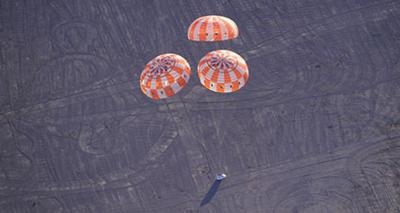
NASA completed the latest in a series of parachute tests for its Orion spacecraft Thursday at the U.S. Army Yuma Proving Ground in southwestern Arizona, marking another step toward a first flight test in 2014. The test verified Orion can land safely even if one of its two drogue parachutes does not open during descent.

NASA says one of the most challenging things the multipurpose vehicle will do is bring its crew home safely. Because it will return from greater distances, Orion will reenter the Earth's atmosphere at speeds of more than 20,000 mph. After re-entry, the parachutes are all that will lower the capsule carrying astronauts back to Earth. "The mockup vehicle landed safely in the desert and everything went as planned," said Chris Johnson, a NASA project manager for Orion's parachute assembly system. "We designed the parachute system so nothing will go wrong, but plan and test as though something will so we can make sure Orion is the safest vehicle ever to take humans to space."

Orion uses five parachutes. Three are main parachutes measuring 116 feet wide and two are drogue parachutes measuring 23 feet wide. The 21,000-pound capsule needs only two main parachutes and one drogue. The extra two provide a backup in case one of the primary parachutes fails.

To verify Orion could land safely with only one drogue parachute, engineers dropped a spacecraft mockup from a plane 25,000 feet above the Arizona desert and simulated a failure of one of the drogues. About 30 seconds into the mockup's fall, the second drogue parachute opened and slowed the mockup down enough for the three main parachutes to take over the descent.

The next Orion parachute test is scheduled for February and will simulate a failure of one of the three main parachutes.

In 2014, an uncrewed Orion spacecraft will launch from Cape Canaveral Air Force Station in Florida on Exploration Flight Test-1. The spacecraft will travel 3,600 miles above Earth's surface. The main flight objective is to test Orion's heat shield performance at speeds generated during a return from deep space.

FMI: www.nasa.gov/orion

Advertisement

More News

Aero-News: Quote of the Day (12.18.25)

“These new aircraft strengthen our ability to respond quickly, train effectively and support communities nationwide. Textron Aviation has been a steadfast supporter in helpin>[...]

Classic Aero-TV: Viking Twin Otter 400--Bringing the DHC-6 Back Into Production

From 2011 (YouTube Edition): Rugged, Legendary, STOL Twin Makes A Comeback The de Havilland Twin Otter is an airplane with a long history, and it gained a reputation as a workhorse>[...]

NTSB Final Report: Rans Employee Flying Club Rans S-6ES Coyote II

A Wind Gust Lifted The Right Wing And The Airplane Turned To The Left Analysis: The pilot was departing from a 2,395-ft-long by 50-ft-wide turf runway. The pilot reported that afte>[...]

ANN FAQ: Submit a News Story!

Have A Story That NEEDS To Be Featured On Aero-News? Here’s How To Submit A Story To Our Team Some of the greatest new stories ANN has ever covered have been submitted by our>[...]

ANN's Daily Aero-Term (12.18.25): Braking Action Advisories

Braking Action Advisories When tower controllers receive runway braking action reports which include the terms “medium," “poor," or “nil," or whenever weather con>[...]

blog comments powered by Disqus



Advertisement

Advertisement

Podcasts

Advertisement

© 2007 - 2025 Web Development & Design by Pauli Systems, LC

