
Air Force: X-37B Historic Landing Advances Space Vehicle Technologies | Aero-News Network
Aero-News Network
RSS icon RSS feed
podcast icon MP3 podcast
Subscribe Aero-News e-mail Newsletter Subscribe

Airborne Unlimited -- Most Recent Daily Episodes

Episode Date

Airborne-Monday

Airborne-Tuesday

Airborne-Wednesday Airborne-Thursday

Airborne-Friday

Airborne On YouTube

Airborne-Unlimited-12.08.25

AirborneNextGen-
12.02.25

Airborne-Unlimited-12.03.25

Airborne-FltTraining-12.04.25

AirborneUnlimited-12.05.25

AFE 2025 LIVE MOSAIC Town Hall (Archived): www.airborne-live.net

Thu, Dec 09, 2010

Air Force: X-37B Historic Landing Advances Space Vehicle Technologies

The 11,000-Pound OTV Made An Autonomous Landing At Vandenberg AFB

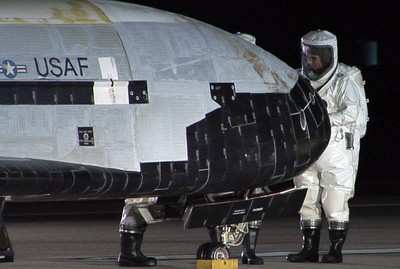
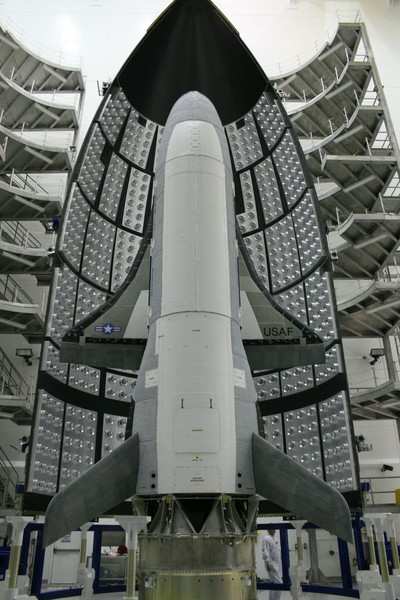
After 244 days in space since its launch April 22 from Cape Canaveral, FL, the X-37B orbital test vehicle landing marks the Air Force's latest step in experimental test missions to improve the service's space capabilities, officials said here Dec. 6.


X-37B Inspected After Landing

The 11,000-pound OTV made an autonomous landing at Vandenberg Air Force Base, CA, Dec. 3 at 0116 PST, allowing the Air Force to begin evaluation of its functions as a satellite communications, weather and material technology asset, said Deputy Under Secretary of the Air Force for Space Programs Richard McKinney. "We're in a very serious and important business of providing national security space capabilities for our nation," Mr. McKinney said. "Some of those capabilities are state-of-the-art, highly complex and very technical, ... and for its first flight, we're extremely pleased with the outcome of the X-37B."

Mr. McKinney said the ability to examine such high-tech technologies as space situational awareness, intelligence, surveillance and reconnaissance, and satellite development before they're made operational is a long-sought-after capability that the X-37B provides. "Now we can test those capabilities long in advance of putting them in operational space," he said, adding that the X-37B functions like other satellites with operators on Earth monitoring its travels -- with one fundamental difference. "The vehicle was commanded to re-enter, and there's a pre-determined routine to fold up the solar array and then do its re-entry burn to reorient to the right position to survive the heat during re-entry," said Lt. Col. Troy Giese, the X-37B program manager for the Air Force Rapid Capabilities Office.

Lt. Col. Giese explained that there is no way to "take over" the vehicle upon landing, but 30th Space Wing range controllers at Vandenberg AFB could terminate the end of the flight had the X-37B broken any of the pre-determined safety boundaries. "The ability to bring a small vehicle that's able to launch, operate and land autonomously is really quite an achievement," Mr. McKinney said. "Hopefully we'll be able to provide a new way for us to develop experiments and technologies for our national security."

Slated to launch in spring 2011, the X-37B OTV-2 orbit will incorporate lessons learned from OTV-1, Mr. McKinney said. "The vehicle performed everything it was asked to do this particular flight, so now we need to see how the materials operated in this long duration and examine the vehicle, since it was designed to operate for long periods of time," he added.

FMI:  www.af.mil

Advertisement

More News

NTSB Final Report: Patriot Aircraft LLC CX1900A

After Draining Both Wing Fuel Tanks, A Significant Amount Of Water Was Observed In The Right Wing Fuel Tank Analysis: The pilot, who was also the owner of the experimental amateur->[...]

Aero-News: Quote of the Day (12.06.25)

“Airbus apologises for any challenges and delays caused to passengers and airlines by this event. The Company thanks its customers, the authorities, its employees and all rel>[...]

ANN's Daily Aero-Term (12.06.25): High Speed Taxiway

High Speed Taxiway A long radius taxiway designed and provided with lighting or marking to define the path of aircraft, traveling at high speed (up to 60 knots), from the runway ce>[...]

ANN's Daily Aero-Linx (12.06.25)

Aero Linx: Taylorcraft Foundation, Inc. The Taylorcraft Foundation is exclusively organized for charitable, educational & scientific activities and will preserve the history an>[...]

Airborne-NextGen 12.02.25: Honda eVTOL, Arctus High-Alt UAS, Samson Patent

Also: USAF Reaper Accident, Baikonur Damage, Horizon eVTOL IFR/FIKI, New Glenn Update Honda has outlined its clearest timeline yet for its entry into the world of electric vertical>[...]

blog comments powered by Disqus



Advertisement

Advertisement

Podcasts

Advertisement

© 2007 - 2025 Web Development & Design by Pauli Systems, LC

