First Flight Tests Planned For 2018
Aurora Flight Sciences has announced that the Defense Advanced Research Projects Agency (DARPA) has awarded the company the prime contract for Phase 2 of the Agency’s Vertical Takeoff and Landing Experimental Plane (VTOL X-Plane) program.
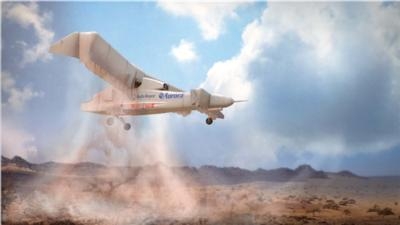
VTOL X-Plane seeks to develop a technology demonstrator that could achieve a top sustained flight speed of 300-400 kt; raise aircraft hover efficiency from 60 percent to at least 75 percent; present a more favorable cruise lift-to-drag ratio of at least 10, up from 5-6 and; carry a useful load of at least 40 percent of the vehicle’s projected gross weight of 10,000-12,000 pounds.
The Aurora team’s design for its unmanned aircraft, named LightningStrike, seeks to provide an approximately 50-percent increase in speed over existing VTOL aircraft designed for comparable mission applications.
“Aurora is proud to support DARPA on what we all hope to be a truly historic breakthrough in aviation technology,” said Dr. John Langford, chairman and CEO of Aurora. “If successful, VTOL X-Plane’s radically improved flight capabilities could lead to revolutionary advancement of the U.S. military’s future mission capabilities. We’re honored to have been selected by DARPA to build and flight test the demonstrator aircraft.”
The technology demonstrator was designed in close collaboration with Aurora’s team members, Rolls-Royce PLC and Honeywell International Inc.
The Aurora-led team intends to deliver a number of aviation milestones with the demonstration aircraft, including being the first aircraft designed to demonstrate:
Distributed hybrid-electric propulsion ducted fans
An innovative synchronous electric-drive system
Both tilt-wing- and tilt-canard-based propulsion for vertical takeoff and landing
High efficiency in both hover and high-speed forward flight
The aircraft design features a Rolls-Royce AE 1107C turboshaft engine that would power three Honeywell generators, and 24 ducted fans distributed on both the wings and canards. The aircraft’s electric distributed propulsion (EDP) system would consist of highly integrated, distributed ducted fans that, combined with the synchronous electric drive system, would enable the design’s potentially revolutionary hover efficiency and high-speed forward flight.
“The Aurora team’s goal is to help redefine the future of vertical flight,” said Mark Wilson, chief operating officer of Rolls-Royce LibertyWorks, an advanced aerospace technology research and design unit. “Rolls-Royce LibertyWorks is proud to contribute both proven components and innovative new technologies in turbo-electric distributed propulsion to this exciting program.”
“Honeywell is proud to be a part of the Aurora team and contribute to this groundbreaking aviation research,” said Carey Smith, president of Honeywell Defense and Space. “Our goal is to demonstrate technology that significantly improves electric power-generation efficiency, power density and size. The improvements are needed to meet the aggressive goals for this very innovative aircraft, and would raise the bar for electric power-generation efficiency that would enable this revolutionary advance in hybrid-electric aircraft propulsion.”
The DARPA technology demonstrator’s flight control system (FCS) builds on the heritage of Aurora’s Centaur and Orion optionally manned and unmanned aircraft platforms. The FCS system runs on a triplex-redundant design to ensure detection and correction of flight anomalies in both vertical and forward flight.
Pending successful completion of key program milestones to be achieved in close collaboration with DARPA, Aurora plans to conduct the first flight tests of the technology demonstrator in the 2018 timeframe.
(Image provided with DARPA news release)



 Aero-FAQ: Dave Juwel's Aviation Marketing Stories -- ITBOA BNITBOB


 See All