
CAP Cadets Get First-Hand Experience On Lunar Project | Aero-News Network
Aero-News Network
RSS icon RSS feed
podcast icon MP3 podcast
Subscribe Aero-News e-mail Newsletter Subscribe

Airborne Unlimited -- Most Recent Daily Episodes

Episode Date

Airborne-Monday

Airborne-Tuesday

Airborne-Wednesday Airborne-Thursday

Airborne-Friday

Airborne On YouTube

Airborne-Unlimited-12.01.25

AirborneNextGen-
12.02.25

Airborne-Unlimited-12.03.25

Airborne-FltTraining-12.04.25

AirborneUnlimited-12.05.25

AFE 2025 LIVE MOSAIC Town Hall (Archived): www.airborne-live.net

Fri, Oct 11, 2024

CAP Cadets Get First-Hand Experience On Lunar Project

Studying Lunar Surface Material For Construction Sites

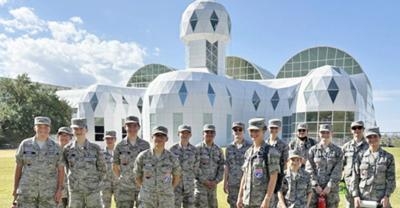
Cadets from the Civil Air Patrol (CAP) Arizona Wing’s Davis-Monthan Composite Squadron 334 had the opportunity to participate in experiments with the University of Arizona’s Biosphere 2 Director, Trent Tresch, studying lunar materials for potential construction on the Moon.

The cadets used some high-tech equipment and got to launch some experiments they developed with Tresch as their submission to the CAP’s national High Altitude Balloon Challenge. One experiment used lunar aggregate from moon rock samples to mix a form of concrete that might be readily available on the lunar surface. The experiment was designed to see how the material behaves at very high altitudes.

In another experiment the cadets used some high-tech sealant to bond space suit material together. The experiment was to determine if space affected the bond sealant positively or negatively.

Tresch said, “The squadron sent prototype lunar concrete to near space in order to better understand the effects of differential pressure, temperature, and radiation on future moon habitats. What better way to connect their experiment to real life than at the Biosphere 2?”

The university says Biosphere 2 is a “laboratory for controlled scientific studies, an arena for scientific discovery and discussion, and a far-reaching provider of public education.” Resident scientists conduct experiments to test space’s potential effects on everyday human activities, and they contribute information that could prove useful for the day when humans might colonize the Moon.

Tresch added, “These cadets are the next generation of explorers, engineers, and scientists, and we want to give them the best tools we can to tackle all future challenges.”

U.S. Air Force Lt. Col. Hans Jagow, Director of the Air Force’s ARCWERX innovation branch, and guided the cadets through the testing and recording of their experimental results.

He observed, “I wanted the cadets to see solutions don’t need to be expensive, hard to obtain, or difficult to create.”

FMI:  www.cap.mil

Advertisement

More News

ANN's Daily Aero-Linx (12.03.25)

Aero Linx: American Aviation Historical Society AAHS is dedicated to the preservation and dissemination of the rich heritage of American aviation. Our purpose is to collect, preser>[...]

ANN's Daily Aero-Term (12.03.25): CrewMember (UAS)

CrewMember (UAS) A person assigned to perform an operational duty. A UAS crewmember includes the remote pilot in command, the person manipulating the controls, and visual observers>[...]

NTSB Prelim: Maule M-7-235A

Immediately After The Right Main Tire Contacted The Runway Surface, The Right Main Landing Gear Failed On October 31, 2025, at about 1227 Pacific daylight time, a Maule M-7-235A, N>[...]

Airborne-Flight Training 12.04.25: Ldg Fee Danger, Av Mental Health, PC-7 MKX

Also: IAE Acquires Diamond Trainers, Army Drones, FedEx Pilots Warning, DA62 MPP To Dresden Tech Uni The danger to the flight training industry and our future pilots is clear. Dona>[...]

Aero-News: Quote of the Day (12.04.25)

"On December 3, 2025, at approximately 10:45 a.m., a Thunderbird pilot ejected safely from a F-16C Fighting Falcon aircraft during a training mission over controlled airspace in Ca>[...]

blog comments powered by Disqus



Advertisement

Advertisement

Podcasts

Advertisement

© 2007 - 2025 Web Development & Design by Pauli Systems, LC

