
Was Charles Lindbergh Really First? | Aero-News Network
Aero-News Network
RSS icon RSS feed
podcast icon MP3 podcast
Subscribe Aero-News e-mail Newsletter Subscribe

Airborne Unlimited -- Most Recent Daily Episodes

Episode Date

Airborne-Monday

Airborne-Tuesday

Airborne-Wednesday Airborne-Thursday

Airborne-Friday

Airborne On YouTube

Airborne-Unlimited-12.08.25

AirborneNextGen-
12.02.25

Airborne-Unlimited-12.03.25

Airborne-FltTraining-12.04.25

AirborneUnlimited-12.05.25

AFE 2025 LIVE MOSAIC Town Hall (Archived): www.airborne-live.net

Fri, Sep 09, 2011

Was Charles Lindbergh Really First?

Aviation Buff Believes French Team Crossed Atlantic, But Crashed

On May 8, 1927, as Charles Lindbergh waited for a clearing in the fog on Long Island to launch for Paris in the Spirit of St. Louis, his rival, French World War I Ace Charles Nungesser, departed with navigator François Coli in the opposite direction. Both were seeking the $25,000 prize offered by hotelier Raymond Orteig for the first crossing of the Atlantic between New York and Paris, considered a key milestone in the development of commercial airline service.

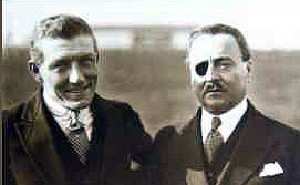
By the time Lindbergh departed 12 days later, there had still been no sign of the French team in New York. A seldom-mentioned sideline to Lindbergh's hero's welcome in Paris is the simultaneous mourning which was underway for (pictured, L-R) Nungesser and Coli who, by then, were presumed lost at sea after last being sighted passing Ireland. Lindbergh is said to have inquired about any news of his rival after his successful landing.

But their biplane, the Oiseau Blanc (or "White Bird"), was never found. It was thought the plane might have made it to Maine and crashed in a wilderness area. Others theorized it might have crashed in Newfoundland.

The Wall Street Journal reports a French aviation enthusiast named Bernard Decré has concluded that the White Bird flew over the south coast of Newfoundland before ditching off the shore of the Canadian mainland. Last year, he discovered a 1927 US Coast Guard telegram in the US National Archives which reported sighting "a pair of joined white wings" three months after the flight. His research of Canadian Maritime weather on May 9, 1927, and interviews with elderly Newfoundlanders who recall witness accounts of the plane passing overhead, have the 71-year-old pilot, and many others in France, excited.

There are now plans to employ divers and sonar to try to locate any part of the Oiseau Blanc. Decré notes poignantly, "We want to establish the true history of the tragic end of our pilots. Then we want to answer Lindbergh's question, by saying we have now had news of Nungesser."

FMI

Advertisement

More News

NTSB Final Report: Patriot Aircraft LLC CX1900A

After Draining Both Wing Fuel Tanks, A Significant Amount Of Water Was Observed In The Right Wing Fuel Tank Analysis: The pilot, who was also the owner of the experimental amateur->[...]

Aero-News: Quote of the Day (12.06.25)

“Airbus apologises for any challenges and delays caused to passengers and airlines by this event. The Company thanks its customers, the authorities, its employees and all rel>[...]

ANN's Daily Aero-Term (12.06.25): High Speed Taxiway

High Speed Taxiway A long radius taxiway designed and provided with lighting or marking to define the path of aircraft, traveling at high speed (up to 60 knots), from the runway ce>[...]

ANN's Daily Aero-Linx (12.06.25)

Aero Linx: Taylorcraft Foundation, Inc. The Taylorcraft Foundation is exclusively organized for charitable, educational & scientific activities and will preserve the history an>[...]

Airborne-NextGen 12.02.25: Honda eVTOL, Arctus High-Alt UAS, Samson Patent

Also: USAF Reaper Accident, Baikonur Damage, Horizon eVTOL IFR/FIKI, New Glenn Update Honda has outlined its clearest timeline yet for its entry into the world of electric vertical>[...]

blog comments powered by Disqus



Advertisement

Advertisement

Podcasts

Advertisement

© 2007 - 2025 Web Development & Design by Pauli Systems, LC

