
Orion Avionics System Ready For First Test Flight | Aero-News Network
Aero-News Network
RSS icon RSS feed
podcast icon MP3 podcast
Subscribe Aero-News e-mail Newsletter Subscribe

Airborne Unlimited -- Most Recent Daily Episodes

Episode Date

Airborne-Monday

Airborne-Tuesday

Airborne-Wednesday Airborne-Thursday

Airborne-Friday

Airborne On YouTube

Airborne-Unlimited-12.08.25

AirborneNextGen-
12.02.25

Airborne-Unlimited-12.03.25

Airborne-FltTraining-12.04.25

AirborneUnlimited-12.05.25

AFE 2025 LIVE MOSAIC Town Hall (Archived): www.airborne-live.net

Wed, Apr 09, 2014

Orion Avionics System Ready For First Test Flight

Team Progressing Toward Exploration Flight Test-1

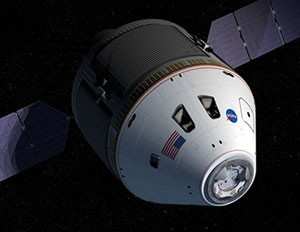
Testing of the Orion spacecraft's avionics system has concluded at the Lockheed Martin [NYSE: LMT] Operations & Checkout facility at Kennedy Space Center in Florida. After powering on and sending commands to more than 20 different critical systems installed on the spacecraft's crew module, NASA and Lockheed Martin engineers have verified the avionics for Exploration Flight Test-1 (EFT-1) are ready to support a successful flight and re-entry of the spacecraft.

Following the initial power on of the Vehicle Main Computer in October, engineers have since methodically installed additional harnessing, wiring and electronics onto the crew module—completing the avionics system that serves as the eyes, ears and brains of the spacecraft. During these tests, engineers one-by-one activated and sent commands to the pyrotechnics, batteries, thermal control, cameras, guidance and navigation, propulsion, and environmental control life support systems, all while evaluating signal quality, on-board system responses, and data production.

"Each and every one of these systems is critical to mission success and they must perform flawlessly to ensure the safety of future crews," said Cleon Lacefield, Lockheed Martin Orion program manager. "Now that we've finished functional testing, the team will conduct performance testing and turn on all the systems at once, simulating the spacecraft's operations during EFT-1."

During Orion's test flight, the uncrewed spacecraft will launch on the Delta IV Heavy and will travel 3,600 miles beyond low Earth orbit. That same day, Orion will return to Earth at a speed of approximately 20,000 mph for a splashdown in the Pacific Ocean. EFT-1 will provide engineers with critical data about Orion's heat shield, flight systems, and capabilities to validate designs of the spacecraft before it begins carrying humans to new destinations in deep space.

(Image from file)

FMI: www.nasa.gov/orion, http://lockheedmartin.com/orion

Advertisement

More News

NTSB Final Report: Patriot Aircraft LLC CX1900A

After Draining Both Wing Fuel Tanks, A Significant Amount Of Water Was Observed In The Right Wing Fuel Tank Analysis: The pilot, who was also the owner of the experimental amateur->[...]

Aero-News: Quote of the Day (12.06.25)

“Airbus apologises for any challenges and delays caused to passengers and airlines by this event. The Company thanks its customers, the authorities, its employees and all rel>[...]

ANN's Daily Aero-Term (12.06.25): High Speed Taxiway

High Speed Taxiway A long radius taxiway designed and provided with lighting or marking to define the path of aircraft, traveling at high speed (up to 60 knots), from the runway ce>[...]

ANN's Daily Aero-Linx (12.06.25)

Aero Linx: Taylorcraft Foundation, Inc. The Taylorcraft Foundation is exclusively organized for charitable, educational & scientific activities and will preserve the history an>[...]

Airborne-NextGen 12.02.25: Honda eVTOL, Arctus High-Alt UAS, Samson Patent

Also: USAF Reaper Accident, Baikonur Damage, Horizon eVTOL IFR/FIKI, New Glenn Update Honda has outlined its clearest timeline yet for its entry into the world of electric vertical>[...]

blog comments powered by Disqus



Advertisement

Advertisement

Podcasts

Advertisement

© 2007 - 2025 Web Development & Design by Pauli Systems, LC

