Sat, Jul 06, 2013
SABRE Hybrid Engine Project Mentioned In Spending Review
New life was breathed into an advanced hybrid jet engine project under development in the U.K. in the Chancellor of the Exchequer's spending review delivered to the British Parliament last week.
Chancellor George Osborne specifically mentioned the SABRE program in his speech, who pledged to fund such high-technology and, in his words, "high-priority" projects, though he did not give any details.
SABRE stand for Synergistic Air-Breathing Rocket Engine. SEN TV reports that it is under development by a company called Reaction Engines based at Abingdon near Oxford in the U.K. In a news release from 2010, the company called the technology "game changing." According to the release, the SABRE engine is capable of operating as a jet engine and a rocket engine, powering aircraft at up to five times the speed of sound within the atmosphere or directly into Earth orbit at twenty-five times the speed of sound. Its ground-breaking technology – an air pre-cooler - is designed to cool continuously the incoming airstream from over 1,000°C to minus 150°C in less than 1/100th of a second (six times faster than the blink of an eye), effectively doubling the current technical limits of jet engine speeds.
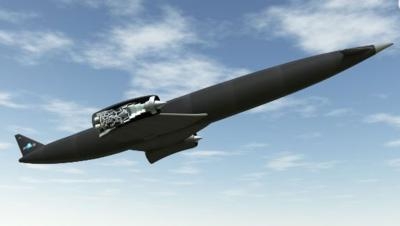
The engine is being developed for a vehicle dubbed Skylon, described as an unpiloted, reusable single stage to orbit (SSTO) space plane "that will provide reliable access to space and be capable of delivering payloads of up to 16 tons into Low Earth Orbit (LEO, approximately 186 miles in altitude) at about 1/50th of the cost of traditional expendable launch vehicles, such as rockets. SKYLON’s SABRE engines use liquid hydrogen combined with oxygen from the air at altitudes up to 16 miles and speeds of up to Mach 5 before switching over to on-board liquid oxygen for the final stage of ascent."
SEN TV says that the company eventually plans to create a version of Skylon that could transport astronauts to the International Space Station. They also envision an airliner, LAPCAT, that could fly from Europe to Australia in just over four hours.
(Skylon image provided by Reaction Engines)
More News
From 2023 (YouTube Edition): New Propulsion Scheme Optimized for AAM Applications Founded in 2017 by Eric Bartsch, Pat Anderson, and Erik Lindbergh (grandson of famed aviation pion>[...]
During The Initial Climb, The Engine Began To Operate Abnormally And, After About Three Seconds, Experienced A Total Loss Of Power On October 29, 2025, about 1820 Pacific daylight >[...]
Aero Linx: Women in Aviation International Women in Aviation International is the largest nonprofit organization that envisions a world where the sky is open to all, and where avia>[...]
“We’ve paid for the cable line’s repair for the customer and have apologized for the inconvenience this caused them...” Source: Some followup info from an A>[...]
“We have long warned about the devastating effects of pairing optimization. Multiple times over many months, we highlighted how schedule manipulation, unbalanced schedules, a>[...]



 Classic Aero-TV: VerdeGo Debuts VH-3 Hybrid-Electric Powerplant


 See All