
NASA, ATK Conduct Successful Shuttle Motor Firing | Aero-News Network
Aero-News Network
RSS icon RSS feed
podcast icon MP3 podcast
Subscribe Aero-News e-mail Newsletter Subscribe

Airborne Unlimited -- Most Recent Daily Episodes

Episode Date

Airborne-Monday

Airborne-Tuesday

Airborne-Wednesday Airborne-Thursday

Airborne-Friday

Airborne On YouTube

Airborne-Unlimited-12.01.25

AirborneNextGen-
12.02.25

Airborne-Unlimited-12.03.25

Airborne-FltTraining-12.04.25

AirborneUnlimited-12.05.25

AFE 2025 LIVE MOSAIC Town Hall (Archived): www.airborne-live.net

Sat, Dec 06, 2008

NASA, ATK Conduct Successful Shuttle Motor Firing

Test Of 7+ Year-Old SRB Engine Also Helps Ares Program

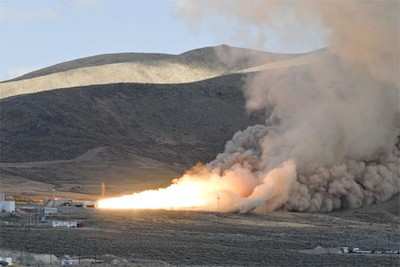
NASA's Space Shuttle Program on Thursday successfully conducted a test firing of a space shuttle reusable solid rocket motor in Utah. The flight support motor, or FSM-15, burned for approximately 123 seconds, the same time each reusable solid rocket motor burns during an actual space shuttle launch.

The test evaluated possible performance changes as shuttle motors age. Space shuttle solid rocket motors are certified for flight for five years from their date of manufacture.

The more than seven-year-old, four-segment motor tested Thursday is the oldest ever fired... and NASA says the results substantiated the certification that was established by NASA at the beginning of the shuttle program.

In addition to its significance to the waning shuttle program, the test also provided important information for continued launches of the shuttle and development of the Ares I rocket, a key component of NASA's Constellation Program that will launch the Orion crew exploration vehicle on missions to the moon.

Ares I test objectives included performance data on a new nozzle design that would increase robustness and measurement of environmental changes caused by motor pressure and sound. This valuable data will assist in the final design of the launch structure for Ares I rockets by engineers from NASA and ATK Launch Systems Group of Promontory, UT -- a unit of Alliant Techsystems Inc. -- which manufactures space shuttle solid rocket motors.

"This test is an example of the aggressive testing program NASA pursues to assure flight safety," said David Beaman, manager of the Reusable Solid Rocket Booster Project Office at NASA's Marshall Space Flight Center in Huntsville, AL. "It also allows us to gather information on how motors with different ages perform."

Preliminary indications are that all test objectives were met. After final test data are analyzed, results for each objective will be published in a NASA report.

The Reusable Solid Rocket Booster Project Office at the Marshall Center managed the test.

A space shuttle launch requires the power of two reusable solid rocket booster motors to lift the 4.5-million-pound shuttle vehicle. Each solid rocket booster burns for approximately 123 seconds and generates an average thrust of 2.6 million pounds. In this latest test, the motor generated 3.3 million pounds maximum thrust for two minutes.

FMI: www.nasa.gov

Advertisement

More News

Classic Aero-TV: VerdeGo Debuts VH-3 Hybrid-Electric Powerplant

From 2023 (YouTube Edition): New Propulsion Scheme Optimized for AAM Applications Founded in 2017 by Eric Bartsch, Pat Anderson, and Erik Lindbergh (grandson of famed aviation pion>[...]

NTSB Prelim: Grumman American Avn. Corp. AA-5B

During The Initial Climb, The Engine Began To Operate Abnormally And, After About Three Seconds, Experienced A Total Loss Of Power On October 29, 2025, about 1820 Pacific daylight >[...]

ANN's Daily Aero-Linx (12.02.25)

Aero Linx: Women in Aviation International Women in Aviation International is the largest nonprofit organization that envisions a world where the sky is open to all, and where avia>[...]

Aero-News: Quote of the Day (12.02.25)

“We’ve paid for the cable line’s repair for the customer and have apologized for the inconvenience this caused them...” Source: Some followup info from an A>[...]

Aero-News: Quote of the Day (12.03.25)

“We have long warned about the devastating effects of pairing optimization. Multiple times over many months, we highlighted how schedule manipulation, unbalanced schedules, a>[...]

blog comments powered by Disqus



Advertisement

Advertisement

Podcasts

Advertisement

© 2007 - 2025 Web Development & Design by Pauli Systems, LC

