
Teams 3D Print Planetary Habitats Awarded $700K In NASA Challenge | Aero-News Network
Aero-News Network
RSS icon RSS feed
podcast icon MP3 podcast
Subscribe Aero-News e-mail Newsletter Subscribe

Airborne Unlimited -- Most Recent Daily Episodes

Episode Date

Airborne-Monday

Airborne-Tuesday

Airborne-Wednesday Airborne-Thursday

Airborne-Friday

Airborne On YouTube

Airborne-Unlimited-12.01.25

AirborneNextGen-
12.02.25

Airborne-Unlimited-12.03.25

Airborne-FltTraining-12.04.25

AirborneUnlimited-12.05.25

AFE 2025 LIVE MOSAIC Town Hall (Archived): www.airborne-live.net

Wed, May 08, 2019

Teams 3D Print Planetary Habitats Awarded $700K In NASA Challenge

Awarded $700K In NASA Challenge

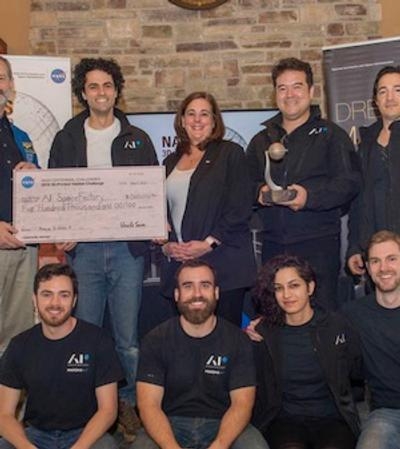
After 30 hours of 3D printing over four days of head-to-head competition, NASA and partner Bradley University of Peoria, Illinois, have awarded $700,000 to two teams in the final round of the 3D-Printed Habitat Challenge. The top prize of $500,000 was awarded to New York based AI. SpaceFactory. Second-place and $200,000 was awarded to Pennsylvania State University of College Park.

The two teams faced off May 1-4 at Caterpillar's Edwards Demonstration & Learning Center in Edwards, Illinois, creating subscale shelters out of recyclables and materials that could be found on deep-space destinations, like the Moon and Mars. The size of the structures had to be a one-third scale version of their architectural designs. Each team employed robotic construction techniques that allowed minimal human intervention. Such technologies will enable more sustainable and autonomous exploration missions.

"The final milestone of this competition is a culmination of extremely hard work by bright, inventive minds who are helping us advance the technologies we need for a sustainable human presence on the Moon, and then on Mars," said Monsi Roman, program manager for NASA's Centennial Challenges. "We celebrate their vision, dedication and innovation in developing concepts that will not only further NASA's deep-space goals, but also provide viable housing solutions right here on Earth."

The habitats were constructed in 10-hour increments in front of a panel of judges. Once printing was complete, the structures were subjected to several tests and evaluated for material mix, leakage, durability and strength.

Beginning in 2015, the multi-year, multi-phase competition challenged teams to demonstrate many different additive manufacturing technologies, from design to software modeling to physical construction. The unique challenge was competed in three phases: design, structural member and on-site habitat construction. The challenge structure allowed NASA to task the teams to address many facets of 3D construction, and to involve a broader range of teams with various expertise. Throughout the competition, more than 60 teams have participated, and NASA awarded over $2 million in prize money.

"It is an impressive achievement for these two teams to demonstrate this disruptive and terrific 3D-printing technology at such a large scale," said Lex Akers, dean of Bradley's Caterpillar College of Engineering and Technology. "By teaming up with NASA and Caterpillar, we are proud to bring these teams together in an environment where they can innovate, create and challenge our vision of what's possible. Congratulations to both teams for their accomplishments."

The 3D-Printed Habitat Challenge is managed through a partnership with NASA's Centennial Challenges program and Bradley University in Peoria, Illinois. Bradley has partnered with sponsors Caterpillar, Bechtel, Brick & Mortar Ventures and the U.S. Army Corps of Engineers to administer the competition. NASA's Centennial Challenges program is part of the agency's Space Technology Mission Directorate, and is managed at NASA's Marshall Space Flight Center in Huntsville, Alabama.

(Source: NASA news release. Images provided)

FMI: www.nasa.gov

Advertisement

More News

Aero-FAQ: Dave Juwel's Aviation Marketing Stories -- ITBOA BNITBOB

Dave Juwel's Aviation Marketing Stories ITBOA BNITBOB ... what does that mean? It's not gibberish, it's a lengthy acronym for "In The Business Of Aviation ... But Not In The Busine>[...]

NTSB Prelim: Rutan Long-EZ

The Pilot Attempted Several Times To Restart The Engine And Diverted To Long Beach Airport/Daughtery Field On October 20, 2025, about 1603 Pacific daylight time, an experimental am>[...]

ANN's Daily Aero-Term (12.05.25): Hazardous Weather Information

Hazardous Weather Information Summary of significant meteorological information (SIGMET/WS), convective significant meteorological information (convective SIGMET/WST), urgent pilot>[...]

Aero-News: Quote of the Day (12.05.25)

"The latest development underscores the government of Malaysia’s commitment in providing closure to the families affected by this tragedy..." Source: From statements made by >[...]

Airborne-Flight Training 12.04.25: Ldg Fee Danger, Av Mental Health, PC-7 MKX

Also: IAE Acquires Diamond Trainers, Army Drones, FedEx Pilots Warning, DA62 MPP To Dresden Tech Uni The danger to the flight training industry and our future pilots is clear. Dona>[...]

blog comments powered by Disqus



Advertisement

Advertisement

Podcasts

Advertisement

© 2007 - 2025 Web Development & Design by Pauli Systems, LC

