Thu, Dec 05, 2013
Witnesses Observed The Plane In A Bank Estimated At 60 To 80 Degrees
The NTSB has issued a probable cause report from an accident which fatally injured the pilot of an amateur-built Sater Coot A-Amphib on November 23 last year.
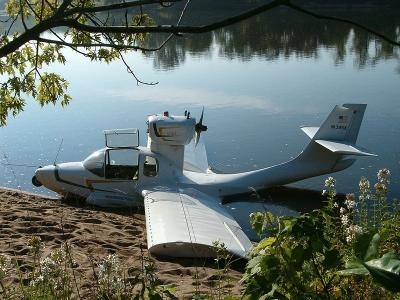
According to the report, a witness observed the airplane in a steep bank (estimated at between 60 and 80 degrees) while turning from the base leg to final approach in the traffic pattern. He then observed the airplane enter a spin and stated the airplane was in a near vertical nose-down attitude when the right wing separated from the airframe. Another witness reported that after the airplane’s first spin revolution, the leading edge came off of a wing and that during the second spin revolution the other wing separated.
A postaccident examination of the airplane revealed that both wings had separated from the airplane about the same spanwise location (about 17 inches outboard of the wing attach points). The right wing’s front spar fracture face showed areas of tension and compression failures of the wood fibers that were consistent with the wing failing in a downward direction. Both the leading edge and front spar of the left wing had diagonal cuts through them that were consistent with having been struck by the airplane’s propeller. The inboard front spar fracture face was examined, but the fiber failures were destroyed by the ground impact, so a directionality of failure could not be determined.
However, the propeller strike on the leading edge and front spar could only occur if the left wing failed upward into the propeller. There were no obvious signs of rot or preexisting conditions in the wood spars examined, and none of the wing attachment bolts failed. The witness reports indicating that the airplane was in a continuous steepening turn from the downwind leg to final approach immediately before the accident and the observed damage suggest that the pilot’s control inputs stressed the airplane’s wings beyond their design capabilities.
The National Transportation Safety Board determines the probable cause of this accident to be the pilot's excessive flight control inputs, which led to flight that exceeded the structural limits of the airplane and resulted in structural failure of both wings.
(Coot-A pictured in public domain file photo. Not accident airplane)
More News
Convective SIGMET A weather advisory concerning convective weather significant to the safety of all aircraft. Convective SIGMETs are issued for tornadoes, lines of thunderstorms, e>[...]
Aero Linx: United Flying Octogenarians WELCOME to a most extraordinary group of aviators, the United Flying Octogenarians (UFO). Founded in 1982 with just a handful of pilots, we h>[...]
Pilot’s Decision To Attempt Takeoff With Frost Covering The Airplane’s Wings Analysis: The pilot of the light sport airplane was preparing to depart for a cross-country>[...]
“We’ve paid for the cable line’s repair for the customer and have apologized for the inconvenience this caused them...” Source: Some followup info from an A>[...]
Coupled Approach An instrument approach performed by the aircraft autopilot, and/or visually depicted on the flight director, which is receiving position information and/or steerin>[...]



 ANN's Daily Aero-Term (12.01.25): Convective SIGMET


 See All